
Vacuum filtration, or suction filtration, is the process of separating a solid from a liquid through a filter element. The vacuum creates a driving force that pulls the liquid through the filter while the solids cake on the outside of the filter. Moreover, vacuum helps to achieve a higher level of dryness which improves yield and recovers a purer liquid. Laboratory and full-scale production environments use this type of filtration.

Industrial Filtration Techniques

In larger scale vacuum filtration applications, rotary vacuum drum filtration is common because dry product is continuously produced. In this process, a vacuum system pulls suction on the inside of a rotating drum covered in a filter element. The liquid is pulled through this filter by the vacuum, while the dry product is scraped from the filter aid via a knife. A liquid spray cleans the solid cake on the outside of the drum near the end of its rotation. The vacuum system must handle this spray, as well.

Protection from Process Carryover

Typically, some process solids pass through the filter element. For large-scale industrial applications, Wintek recommends a liquid ring vacuum system. These pumps handle small amounts of both liquid and solid carryover without hindering performance. However, if a significant amount of process carryover passes through the filter, Wintek recommends implementing a knockout pot. These vessels give the vacuum pump an extra layer of protection from process carryover.

Wintek designs full-recovery liquid ring packages because this system configuration allows the customer to collect the solvent, usually water, for reuse. From a vacuum system design perspective, vacuum filtration can be similar to vacuum drying.
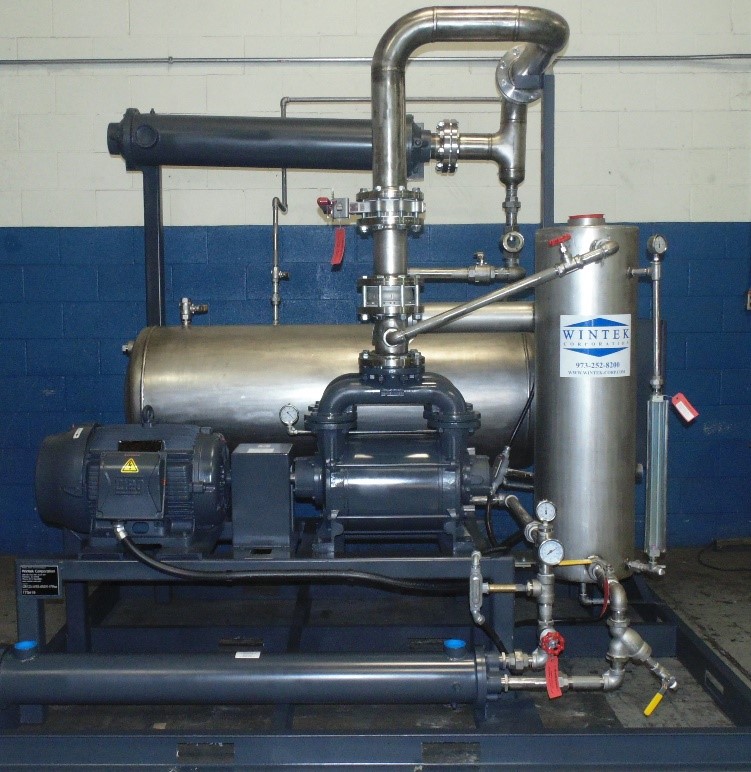
vacuum filtration, condenser, receiver tank, liquid ring vacuum system
Wintek condenser/receiver, large capacity liquid ring vacuum system, for use in vacuum filtration

FAQs about Vacuum Filtration

Vacuum filtration is a solid liquid separation process that uses a pressure differential, created by applying vacuum on the downstream side of a filter medium, to pull liquid through the filter while solid particles are retained on the medium’s surface, forming a filter cake. This pressure differential speeds up filtration significantly compared to gravity filtration alone.

Vacuum filtration significantly increases filtration rate by actively pulling liquid through the filter medium rather than relying solely on gravity, which allows for faster processing, handling of higher solids content slurries, and better control over cake formation and washing compared to gravity based methods alone.

Common types include rotary drum vacuum filters, which continuously form and discharge filter cake as a rotating drum passes through a slurry trough, belt filters that use a moving filter belt under vacuum, and nutsche filters, which are batch style vessels that apply vacuum to a fixed filter bed.

A rotating drum covered with filter medium is partially submerged in a slurry tank, with vacuum applied internally as the drum surface passes through the slurry, drawing liquid through the medium while solids build up as a cake on the drum surface, which is then dried, washed if needed, and scraped off as the drum continues to rotate through the cycle.

Liquid ring vacuum pumps are the most common choice for filtration applications, since they reliably handle the moisture, occasional liquid carryover, and fine particulate that can be present in filtration off gas, providing a robust and dependable vacuum source for continuous filtration operations.

A filtrate receiver is a vessel positioned between the filter and the vacuum pump that collects the liquid pulled through the filter medium, separating it from the air or gas stream before that gas reaches the vacuum pump, protecting the pump from excessive liquid loading and allowing the collected filtrate to be drained or pumped away separately.

As filter cake builds up on the medium, it adds resistance to flow, which generally slows the filtration rate over time, so many systems are designed with cycle times or cake thickness limits in mind to maintain efficient throughput before the cake is removed or the filter cycle resets.

Key factors include the applied vacuum level, the particle size distribution and characteristics of the solids, the filter medium’s pore size and permeability, slurry concentration, and cake thickness, all of which interact to determine both filtration rate and the clarity of the resulting filtrate.

Washing the filter cake with a wash liquid while still under vacuum helps remove residual mother liquor or soluble impurities trapped within the cake structure, which is often necessary to meet product purity specifications or to recover valuable filtrate that might otherwise remain trapped in the cake.

Common causes include filter medium blinding or fouling from fine particles clogging the pores, excessive cake thickness building up faster than it can be removed, insufficient vacuum level due to pump wear or air in leakage, and slurry characteristics that change over time, such as particle size or viscosity shifts.

Blinding occurs when fine particles become lodged within the pores of the filter medium, reducing its permeability and filtration rate over time, and is typically addressed through proper filter medium selection for the specific slurry characteristics, periodic cleaning or medium replacement, and sometimes pretreatment of the slurry to reduce fine particle content.

Mining and mineral processing, wastewater and sludge treatment, chemical and pharmaceutical manufacturing, food and beverage processing, and pulp and paper production all commonly use vacuum filtration for solid liquid separation needs specific to their processes.

Higher solids concentration slurries generally form thicker cakes more quickly, which can be advantageous for solids recovery applications but may also require adjustments to vacuum level, drum speed, or cycle time to maintain effective filtration and prevent excessive resistance from cake buildup.

Regular attention to filter medium condition and cleanliness, vacuum pump performance and seal liquid management, inspection of seals and connections for air in leakage, and monitoring of filtrate clarity and cake characteristics are all important for keeping vacuum filtration systems operating efficiently over time.