Liquid Phase Molecular
Sieve Dehydration

Wintek SN 23170

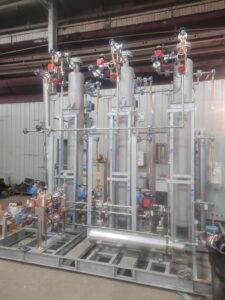
Wintek SN 23170: 12 gpm IPA dehydration unit

This Liquid Phase MSDU Design passes a liquid stream of wet alcohol or solvent through a column filled with molecular sieve beads in a process known as molecular sieve dehydration.

The bed of sieve beads adsorbs water molecules from the liquid as it passes through it. This occurs due to polar attraction. The internal surfaces of the molecular sieve adsorbs more of the water as the bulk liquid flows through the column. This continues until the molecular sieves are at capacity, and dried alcohol product (or solvent) exits the column.

This process continues until the sieve becomes saturated with water, at which time the molecular sieve must be changed, or regenerated. Similar to Wintek’s gas phase MSDUs, our liquid phase MSDUs use temperature swing adsorption to regenerate the beads.

Regenerating the sieve typically involves 1) draining the liquid, 2) heating the sieve beads, 3) purging the gas either at pressure or under vacuum, and lastly, 4) cooling the sieve.

Wintek’s Internally Heated Short Path(SP) Design

Wintek’s unique MSDUL Liquid Phase Molecular Sieve design utilizes internal heating for temperature swing adsorption, which offers the following advantages:

  • Very Dry Product to less than 10 ppm
  • Low energy consumption
  • Very high product recovery due to the low purge gas requirements: >99% recovery
  • Very high thermal efficiency with the short gas path for thermal transfer
  • High thermal efficiency means shorter regeneration cycle
  • A shorter regeneration cycle enables higher processing rates
  • Fully piped and wired packaged units
  • Fully automated, reducing operator

Externally Heated MSDUs

In Externally Heated MSDU Designs, purging hot dry gas (generally Nitrogen) through the bed, or circulating a hot gas with a partial purge heats up the mole sieve beads.

The low heat content of nitrogen (used to heat and cool the bed) and the relatively large amount of energy required to change the temperature of the beds causes externally heated designs to suffer from long regeneration times.

Relatively high purge gas rates which are exhausted with saturated vapors cause this design to suffer from higher emissions even though condensers are used.
FAQs about Liquid Phase Molecular Sieve Dehydration

It’s a process that removes dissolved water from a liquid solvent stream by passing the liquid through a bed of molecular sieve adsorbent, which selectively traps water molecules while allowing the solvent molecules to pass through.

The core adsorption principle is the same, but liquid phase units process a liquid stream rather than a gas stream. Liquid phase units are typically able to achieve very low product water concentrations.

Selection depends on the specific hydrocarbon being treated and any co-adsorption concerns, but common choices are 3A or 4A pore size sieves, chosen to selectively adsorb water while minimizing unwanted adsorption of solvent molecules from the liquid stream.

Regeneration typically uses a heated gas or vapor stream passed through the saturated bed to drive off adsorbed water, followed by a cooling step, with multiple beds arranged so one remains in service while another regenerates.

Common causes include contamination from heavy hydrocarbons, glycol, methanol, or other co-adsorbing compounds that compete with water for active sites, mechanical breakdown of sieve beads from liquid flow stress, and inadequate regeneration that leaves residual moisture on the sieve.

In some cases, yes, depending on pore size, certain sieves can also adsorb small polar molecules like methanol, which is relevant in applications where methanol injection is used upstream for hydrate prevention and must be managed to avoid competing with water adsorption.

Wintek’s systems can be designed to achieve water content of less than 10 ppm, but commonly achieve moisture content in the low single-digit ppm range.

Design choice depends on the specific system, but flow direction affects bed packing stability, pressure drop, and the potential for channeling or fluidization of the sieve bed, so it’s an important consideration during system design to ensure consistent contact time and adsorption performance.

Upstream filtration is important to remove particulates, free water, or other contaminants before the liquid reaches the sieve bed, since these can foul the sieve surface, increase pressure drop, and shorten the effective service life of the adsorbent.

Service life varies by application and feed quality, but is commonly in the range of several years, with contamination, poor pre-treatment, or inadequate regeneration practices significantly shortening that lifespan, similar considerations to vapor phase systems.

Natural gas processing and NGL fractionation facilities, LPG production, petrochemical plants producing polymer-grade products, and any facility needing to protect downstream moisture-sensitive processes from water contamination in a liquid solvent stream.

Because liquid flow generally creates higher pressure drop than gas flow through an equivalent bed, systems are engineered with appropriate bed sizing, sieve bead size, and flow velocity limits to keep pressure drop within acceptable operating limits while still achieving adequate contact time for adsorption.