
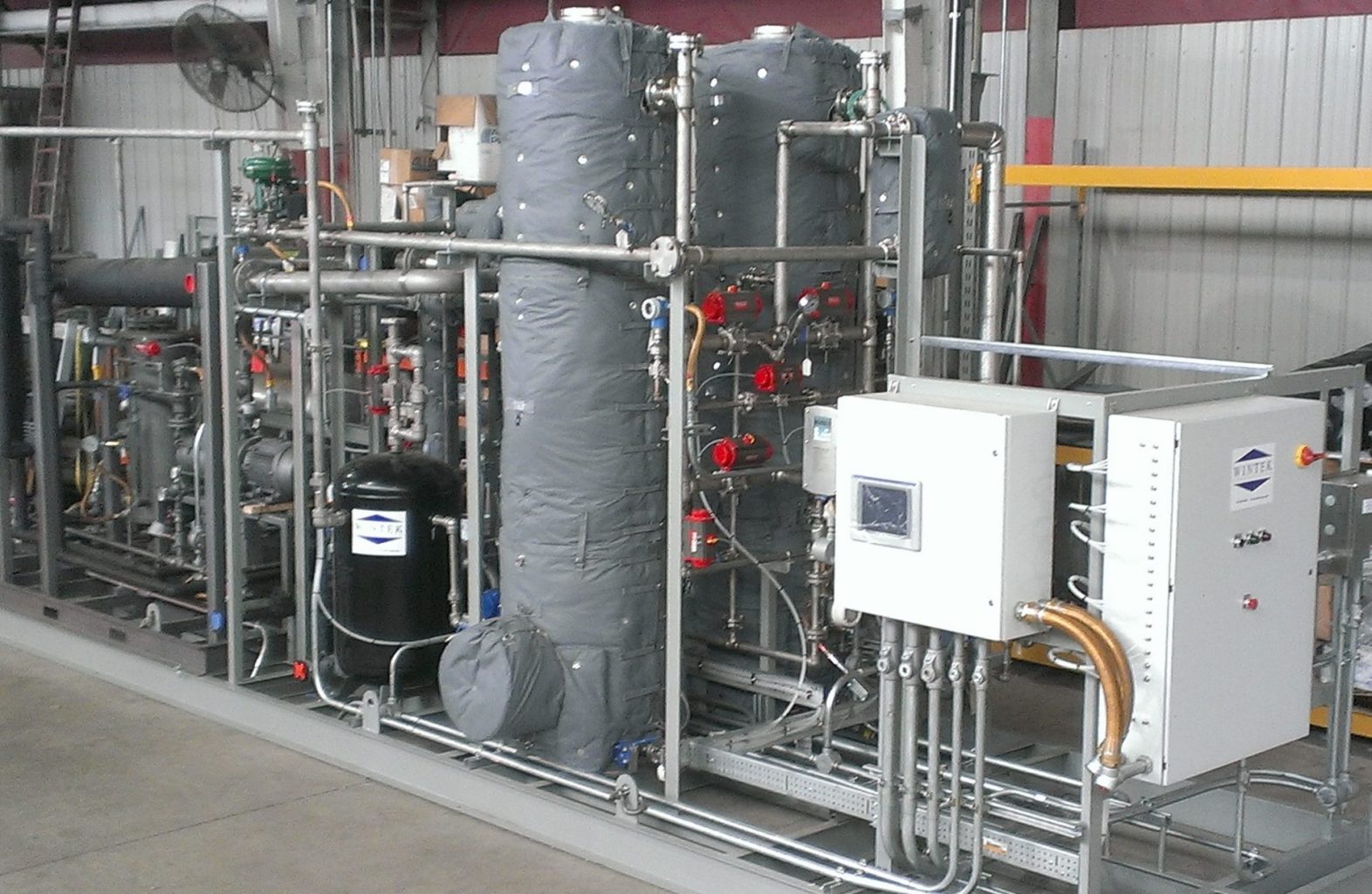
Vapor Phase Molecular Sieve Dehydration

Pressure Swing Adsorption

Gas Phase Molecular Sieve Dehydration System

Wintek SN 130114: 400 liter/hr (7 gpm)Methanol/water w/ 5.0wt% water; 677 #/hr Methanol; up to 35#/hr water (5wt%)

The Vapor Phase molecular sieve dehydration unit design passes a wet alcohol (or solvent) stream in vapor state at a controlled pressure through a column filled with molecular sieve beads.  As the vapors pass through the bed of molecular sieve beads, the beads draw the water into their internals by polar attraction, while leaving the remaining vapors dehydrated as they exit the column.

At a defined cycle time, the vapor flow is diverted to a second mole sieve column to allow the process vapors to be continuously dehydrated, while the first mole sieve column is regenerated using pressure swing adsorption.

Reducing the pressure and/or by pulling a vacuum on the column, attains regeneration, while using a purge gas helps to strip the water out of the molecular sieve beads. Commonly used purge gasses are N2 or process solvent which has already been dehydrated by the column. Some designs use up to 30% of the process flow as a purge gas. However, Wintek is able to accomplish this using only 5-10%.

Wintek’s Patented Vapor Phase MSDUs are high efficiency designs that:

  • Provide 90-95% solvent recovery rates
  • Consume less energy than competing technologies
  • Require minimal operator intervention
  • Handles a wide variation in feed concentrations (0-10% by mass)
  • Provide high purity:
    • Standard Dryness: 99.5% (5,000 ppm water)
    • Extra Dry: 99.9% (1,000 ppm water)
    • Ultra-Dry: 99.95% (500 ppm water)
  • Process from ½ gpm to over 25 gpm of wet alcohols/solvents
  • Deliver as packaged units, fully piped and also wired

FAQs about Vapor Phase Molecular Sieve Dehydration

It’s a process that removes water vapor from a gas stream by passing it through a bed of molecular sieve adsorbent (a synthetic zeolite) while the gas remains in its vapor phase. The sieve’s uniform pore structure selectively adsorbs water molecules while allowing the rest of the gas stream to pass through, achieving very low residual moisture content.

Molecular sieves are highly porous crystalline materials with pore openings of a precise, uniform size, typically 3, 4, 5, or 10 angstroms depending on the sieve type. Water molecules are small enough to enter these pores and get trapped by adsorption forces, while larger gas molecules pass through the bed largely unaffected, provided the correct pore size is selected for the application.

Molecular sieves can achieve much deeper dehydration than glycol systems, often down to single-digit ppm moisture levels, making them the preferred choice for applications like cryogenic gas processing or LNG production where even trace moisture would cause icing or hydrate formation downstream.

Vapor phase dehydration processes the solvent while it is a gas, as opposed to liquid phase processes where a liquid is dehydrated instead. Selection of gas-phase vs liquid-phase technology depends on a number of factors such as feed phase, incoming moisture content, and dehydration requirements.

Most systems use two or more beds arranged so that one bed is actively adsorbing water while another is being regenerated (having its accumulated water driven off), allowing continuous, uninterrupted dehydration of the process gas stream without shutting down for regeneration.

Regeneration of a vapor phase MSDU typically involves pulling vacuum through the saturated bed in reverse flow, which drives off the adsorbed water. The bed is then repressurized before being placed back into service, completing the cycle.

Cycle time depends on the moisture content of the incoming gas, the flow rate, the bed’s adsorption capacity, and the desired outlet moisture specification. Wintek designs systems around a cycle time balancing sieve life against equipment and regeneration energy costs.

Sieves gradually lose adsorption capacity due to thermal cycling stress, mechanical attrition from gas flow, and contamination from liquids, heavy hydrocarbons, or other compounds that can coat or foul the sieve’s active sites, contaminant fouling is often the leading cause of premature sieve replacement.

Yes, depending on pore size, certain molecular sieves can also selectively remove other small molecules such as CO2, H2S, or mercaptans in addition to water, which is why sieve type selection is application-specific rather than one-size-fits-all.

Chemical processing, natural gas processing, air separation plants, and any process requiring extremely low moisture specifications where glycol or other dehydration methods can’t achieve the required dryness.

Wintek designs vapor-phase MSDU systems to achieve a water content of less than 0.5 wt%, although systems routinely outperform this specification. Where even lower moisture levels are required, Wintek can utilize liquid-phase dehydration.

Common causes include inlet gas contamination (liquid slugs, heavy hydrocarbons, or particulates fouling the sieve), inadequate regeneration (insufficient temperature or gas volume to fully drive off adsorbed water), channeling within the bed due to poor packing, and simply operating past the sieve’s useful service life without replacement.

Rising pressure drop across a bed over time often indicates fouling, sieve attrition/breakdown into fines, or bed settling, and is commonly monitored as a key indicator of when sieve replacement or bed maintenance is needed.

Most of Wintek’s vapor-phase MSDU systems use pressure swing adsorption/regeneration, which invloves pulling vacuum on the bed to regenerate the sieve. Wintek’s expertise in process vacuum design allows us to design these systems for efficient and reliable operation.

This varies widely by application and gas conditions, but sieve life commonly ranges from 3 to 5 years under normal operating conditions, with contamination, poor regeneration practices, or off-spec feed gas significantly shortening that lifespan.