
Boosted Liquid Ring Systems

Boosted Liquid Ring Vacuum System | Complex Vacuum Systems

Boosted Liquid Ring Vacuum System | Complex Vacuum Systems

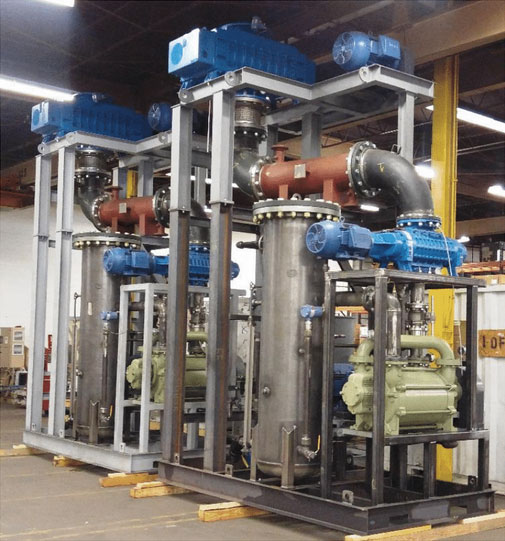
In many process applications, liquid ring vacuum pumps (LRVP) are preferred due to their inherent high reliability, forgiving design, and low maintenance requirements. The main drawback to LRVPs is their limited deep vacuum capabilities because of their reliance on the sealant vapor pressure. This can easily be overcome via the addition of booster pumps to  the inlet of the liquid ring pump. The system will then operate below the sealant vapor pressure.

While the booster extends the operating range of the liquid ring system, it also adds a great deal of complexity in regards to sizing the vacuum pump. Wintek draws on 30+ years of experience in designing boosted systems. Our expertise ensures that our booster systems can operate safely over the entire operating range and avoid overheating of the vacuum pump. We also ensure that the liquid ring pump can adequately back the booster even with contaminated solvents. Wintek utilizes a proprietary sizing program capable of simulating complex vacuum systems with a variety of process conditions and components.

Wintek specializes in designing robust vacuum systems, with capacities reaching up to 10,000 ACFM. We are one of the few vendors with the expertise to engineer systems that can operate at pressures as low as 0.03 Torr, using liquid ring pumps as a backing. When choosing a boosted system supplier, it’s crucial to evaluate their capabilities to ensure you acquire a system with a full operating range that won’t overheat or shut down.

FAQs about Boosted Liquid Ring Systems

A boosted system pairs a liquid ring vacuum pump with a mechanical booster (typically a Roots-type blower) installed upstream of it. The booster handles the low-pressure, high-volume stage while the liquid ring pump acts as the backing pump, together achieving deeper vacuum levels than a liquid ring pump could reach on its own.

A single liquid ring pump becomes increasingly inefficient at deep vacuum because the seal liquid’s own vapor pressure sets a practical floor on how low it can pull. A booster compresses gas from very low pressure up to a level the liquid ring pump can efficiently handle, extending the overall system’s vacuum range without oversizing the liquid ring pump itself.

While a single-stage liquid ring pump typically bottoms out around 50–100 Torr, boosted systems can commonly reach into the 1–10 Torr range, and multi-stage boosted configurations can go even deeper depending on design.

The booster uses two counter-rotating lobed rotors that trap and move gas from the low-pressure (process) side to the higher-pressure (liquid ring pump) side without internal compression, it’s a transfer device, not a compressor in itself, which is why it needs the liquid ring pump downstream to actually discharge against atmosphere.

Boosters are typically most effective below a certain crossover pressure (often around 50 Torr or lower), since at higher pressures the pressure differential across the booster becomes too large for it to operate efficiently or safely. Wintek’s systems use bypass valves or automatic controls as needed to engage the booster only once the liquid ring pump has pulled the system down to that crossover point.

Because Roots boosters can overheat if the pressure differential across them gets too large, systems typically include controls and protections such as VFD and discharge temperature monitoring, protecting the booster rotors from thermal or mechanical stress.

Yes, largely because the liquid ring backing pump still provides the same vapor-handling and liquid-tolerant characteristics as a standalone liquid ring pump. The booster itself, however, is a dry component and generally shouldn’t see significant liquid slugs, so upstream separation or careful process control is still important.

Often yes, particularly at deep vacuum levels, because the liquid ring pump can be sized smaller and doesn’t have to work as hard against a large pressure ratio, while the booster efficiently handles the bulk of the low-pressure volumetric flow with relatively low power consumption per unit of gas moved.

Single-booster configurations are most common, but two boosters in series (sometimes with an intercooler between stages) can be used for applications needing very deep vacuum.

Applications requiring deeper vacuum than a standalone liquid ring pump can efficiently deliver, such as vacuum distillation, solvent recovery at low pressures, freeze drying, degassing, and certain chemical processing steps, commonly use boosted configurations.

In many cases, yes, provided the existing pump has adequate capacity to serve as a backing pump and the process piping can accommodate the added booster and any necessary bypass/control valves. Wintek can provide a proper engineering evaluation before retrofitting.