
Methanol is a key reactant in the transesterification step during production of biodiesel, often identified as dimethyl ether (DME). When the methanol reacts with vegetable oils or animal fats, it produces a usable fuel. During this step, methanol becomes saturated with water and is no longer usable for further transesterification. It is common to continuously purchase fresh methanol; however, it is possible and significantly cheaper to reuse the wet methanol. To keep costs down and lower waste, it is important to dehydrate the methanol in order to recycle it back into the reaction. After frequently passing the water saturated methanol through a methanol dehydration step, it can be recycled. Further transesterification steps utilize the newly dehydrated methanol. One method of methanol dehydration is via molecular sieve dehydration units (or MSDUs).
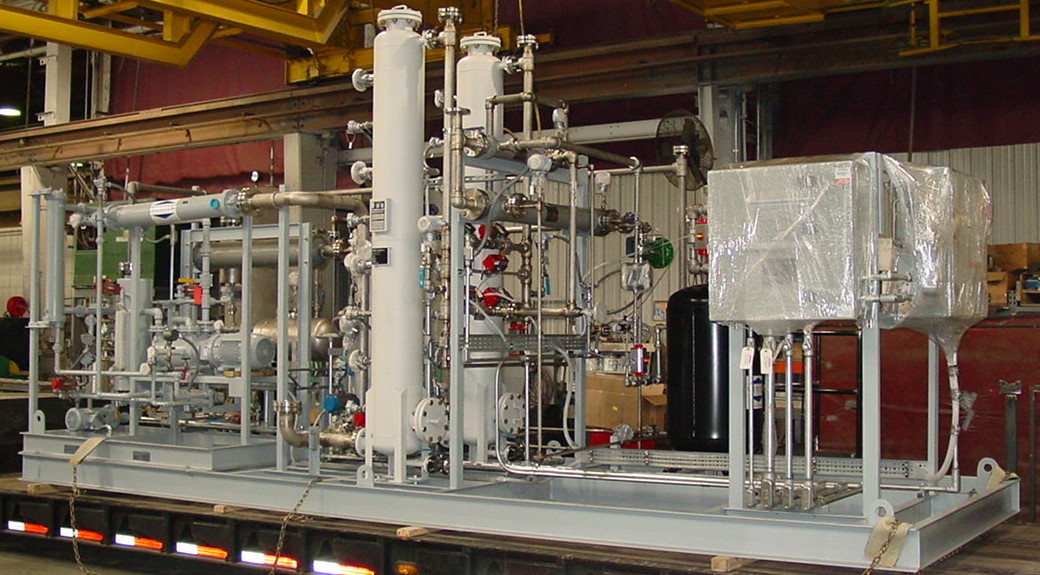
methanol molecular sieves

In a MSDU, the wet methanol passes through a vessel filled with molecular sieve beads. On the surface of these beads, there are small pores that absorb molecules. The pore sizes (usually 3A in size for methanol dehydration) are large enough to allow water (2.6A) to absorb into the pores through yet smaller enough to prevent methanol (~4.5A). The sieves adsorb the water and allow the methanol to pass through the bed. Dry methanol exits the vessel while the water remains trapped in the molecular sieve beads. Heaters and vacuum systems remove the adsorbed water from the wet beads and the dehydration process is repeated.

Wintek designs and builds methanol molecular sieves (MSDUs) (both Liquid Phase and Vapor Phase), depending upon the incoming water concentration and product dryness requirements. 

FAQs about Methanol Dehydration Using Molecular Sieve Dehydration Units (MSDUs)

No, this is an important distinction. Methanol and water are fully miscible and do not form an azeotrope, so conventional distillation alone can, in principle, separate methanol and water to very high purity levels, but this would be constrained by equipment size, cost, and operating expenses, which can be alleviated by use of MSDU technology. Find out more about Wintek’s MSDU technology for cost effective methanol dehydration solutions.

While distillation can achieve high methanol purity, driving water content down to very low trace levels (parts-per-million range) can still require significant energy and very tall/efficient columns. Molecular sieve dehydration is often used as a polishing step to economically reach ultra-low moisture specifications that would otherwise require impractically large or energy-intensive distillation systems. Contact Wintek or submit an inquiry for a dehydration system to find out more about how we can meet your specific needs for methanol dehydration.

Certain specialty chemical processes, some fuel applications (like methanol used in specific fuel cell or blending applications), and particular industrial uses where trace water content must be tightly controlled may call for supplemental dehydration beyond what standard distillation economically provides.

The same general principle applies as with other alcohols, methanol vapor is passed through a bed of molecular sieve adsorbent sized to selectively trap water molecules while allowing methanol to pass through, though because methanol is a smaller molecule than ethanol or IPA, sieve pore size selection requires extra care to avoid excessive methanol co-adsorption.

This requires more careful selection than with ethanol or IPA, because methanol is a smaller molecule, a 3A sieve (commonly used for ethanol/IPA) may still adsorb some methanol alongside water, so sieve selection and performance testing for the specific application are especially important to balance water removal against methanol product loss. Wintek’s experienced team works with each customer to make sure the appropriate sieve is selected according to each customer’s requirements. Submit an inquiry for one of Wintek’s dehydration systems.

Where MSDUs are used for methanol polishing, vacuum regeneration can offer the same energy-saving benefits seen in ethanol and IPA systems, lowering the temperature needed to desorb water from the sieve bed, with a liquid ring vacuum pump commonly used to generate that vacuum, provided seal liquid compatibility with methanol vapor is properly managed.

Similar to other alcohol dehydration systems, the desorbed vapor stream (containing some recoverable methanol along with water) is typically condensed and routed back into the process for reprocessing, minimizing methanol product loss. Wintek’s dehydration systems achieve high levels of efficiency and minimize methanol loss.

Similar failure modes to other alcohol MSDUs apply, sieve fouling from process contaminants, incomplete regeneration leaving residual moisture, and general sieve degradation over repeated cycling, with the added consideration of monitoring methanol co-adsorption/product loss given methanol’s smaller molecular size relative to water-selective pore openings. The efficient design and construction of Wintek’s dehydration systems ensures consistent moisture removal, minimizes methanol loss, and extends sieve life through optimized design and regeneration control.

High-purity distillation alone can often achieve methanol purities well into the 99%+ range with low water content; where an MSDU polishing step is added, moisture content can be pushed down further into the low ppm range for applications with especially strict specifications. Wintek’s MSDUs can reach ultra-dry methanol purities with less than 500 ppm water.

Specialty and fine chemical manufacturing, certain fuel-grade or fuel-cell methanol applications, and other niche industrial processes requiring unusually low trace moisture content beyond typical commercial methanol specifications. Wintek’s designs are suited for these specifications as they can reach purities of less than 500 ppm of water while reducing long-term operating costs.