
Dry Vacuum Pumps are the newest development in the vacuum pump industry. They offer a number of advantages over the traditional vacuum pump designs. There is “No Oil, No Water” in contact with the process vapors which makes them environmentally friendly. There are two markets of dry pumps: Industrial and Chemical.

NOTE: there is a very common misconception that “No Oil, No Water” also means “No Maintenance, No Problems”. ALL vacuum pumps have advantages and disadvantages, including Dry Vacuum Pumps. Reviewing your application with a company, like Wintek, who are experts in vacuum applications, but who are not trying to “sell” you on a particular manufacturer’s design, can save you from using the wrong vacuum pump for the application.

Industrial Dry Vacuum Pumps

Industrial dry vacuum pumps include: regenerative blowers, rotary lobe blowers, dry rotary vane vacuum pumps, and more recently dry single stage “claw” designs, and even newer screw designs. Most of these designs are limited in vacuum to about 15-24”HgV. If your process is dry air, free of solids, then these may be worth considering. If the process gases contain moisture, droplets or solids, taking caution is necessary.
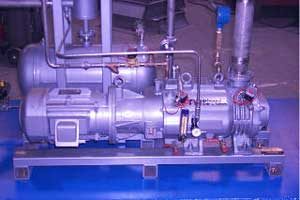
Chemical Duty Dry Vacuum PumpChemical Duty Dry Vacuum Pumps

Solvents can be condensed and recovered on the discharge side of the vacuum pump. This makes this design a good choice for solvent recovery. All the chemical duty dry pumps can pull vacuum levels to 5 to .05 Torr depending upon the design. These advantages come at a relatively high cost, compared to other technologies. There are three major types of chemical duty dry vacuum pumps: screw, multi-lobe, and Claw.
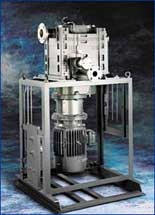
Dry Claw Vacuum Pump

Dry Claw Vacuum Pump

All the manufacturers say that their dry pumps can handle corrosive vapors, and this is true to some extent. Dry vacuum pumps are “dry”, so there is no natural internal flushing of the process out of the vacuum pump. Corrosives are “handled” by keeping them as vapors, and not allowing them to condense. You must use special caution when handling corrosives, using start-up and shut-down purge cycles, and while protecting the pump from process upsets. Coatings on the screw type dry vacuum pumps is advertised as offering corrosion protection. However, for some manufacturers, this offers limited protection because the coating is in reality a wear coating for manufacturing and not “pin-hole free”. For the cooler operating dry pumps (350°F and less), with a PFA or other Teflon type coating, you can have more confidence that the coating is not actually a wear coating, and the coating will hold up better.

Some Dry pumps can also run HOT, some even in excess of 500°F. So potential auto-ignition concerns of some solvents can be a huge potential safety liability. Also, since they run hot, polymerization of process vapors can build up on the close running components. This creates maintenance problems, or removal of the wear coating. Even cool running dry pumps can have polymerization, because most of these dry pumps only cool the claws or screws with an air bleed into the process, so the rotating claws and screws become the hottest part of the pump.

FAQs about Dry Vacuum Pumps

A dry vacuum pump compresses and moves gas without the use of any sealing liquid or lubricating oil in the pumping chamber, relying instead on close mechanical tolerances between internal components, as opposed to liquid ring or oil sealed pumps that use a liquid medium to create the compression seal.

Common types include dry screw pumps, which use intermeshing rotating screws to move and compress gas, claw pumps, which use rotating claw shaped rotors, scroll pumps, which use an orbiting spiral element, and dry rotary vane or diaphragm pumps, each suited to different flow rates, vacuum depths, and application requirements.

Dry pumps avoid the cost, handling, and disposal considerations associated with seal liquid or oil, eliminate the risk of process contamination from that liquid, generally consume less energy since there’s no liquid to accelerate and recompress, and are often preferred where clean, uncontaminated exhaust or process gas is a priority.

Dry pumps are generally less tolerant of liquid slugs, condensable vapors, and particulates than liquid ring pumps, since their close internal tolerances can be damaged or fouled by these conditions, and they often carry a higher upfront capital cost, particularly for pumps designed to handle more challenging process gas conditions.

Two intermeshing screw rotors turn in opposite directions without touching each other or the housing, progressively trapping and compressing gas as it moves along the screw profile from the inlet toward the discharge, with the non-contacting design allowing dry operation without internal lubrication.

A claw pump uses two claw shaped rotors that also turn without contacting each other, but the compression profile and rotor geometry differ from a screw pump, generally making claw pumps well suited to handling process gases with some particulate or light contamination while still maintaining dry, oil free operation.

A scroll pump uses one fixed and one orbiting spiral shaped scroll element that trap and compress gas as the orbiting scroll moves relative to the fixed one, and this technology is commonly used in smaller scale applications such as laboratory, analytical, and semiconductor processes where clean, quiet, oil free vacuum is important.

Handling capability varies by pump type and design, but dry pumps generally have more limited tolerance for condensable vapors and moisture than liquid ring pumps, since condensation inside the pump can affect performance or cause corrosion, though some dry pump designs include features like heated stators or gas purges specifically to manage this limitation.

Purge gas or heating can help prevent process vapors from condensing inside the pump chamber, protecting internal components from corrosion, buildup, or damage that could otherwise occur if condensable vapors were allowed to liquefy within the pump’s close tolerance internals.

Because dry pumps rely on precise internal clearances rather than a liquid seal, maintenance often focuses on monitoring for wear, contamination buildup, or corrosion inside the pump, along with bearing and seal inspection, since there’s no seal liquid to help flush out or tolerate minor process upsets the way a liquid ring pump would.

Dry pumps are generally more energy efficient than liquid ring pumps for clean, dry applications, since there’s no energy lost accelerating and recompressing a seal liquid, though this advantage diminishes or reverses in applications involving heavy liquid carryover or condensable vapors where a dry pump may need additional protective measures.

This varies significantly by pump type and staging, but many dry pump technologies can achieve deep vacuum levels comparable to or exceeding what liquid ring pumps can reach, with some multi-stage dry pump designs suited to high vacuum or ultra-high vacuum applications where liquid ring technology isn’t practical.

Semiconductor and electronics manufacturing, pharmaceutical processing, food packaging, analytical and laboratory instrumentation, and various clean process applications where oil or liquid contamination cannot be tolerated commonly rely on dry vacuum pump technology.

Corrosive, particulate laden, or condensable gas streams may favor claw pump designs with more robust tolerance for these conditions, while cleaner, drier applications might be well served by screw or scroll pump technology.