
Vacuum deaeration removes dissolved gasses from a liquid stream. Because boiler streams contain dissolved oxygen and carbon dioxide, the boiler industry uses vacuum deaeration frequently.

The Boiler Industry and Vacuum Deaerators

In the boiler process, oxygen and carbon dioxide become dissolved in liquid streams. This is an issue because oxygen causes corrosion and carbon dioxide is acidic. Thus, the pH level of the boiler stream can be low. These compounds produce acid that corrodes the boiler system. Vacuum deaerators remove dissolved gasses from boiler feeds. Removing these gasses via vacuum is more economical than removing them through chemicals. The systems reduce corrosion in boiler tubes caused by dissolved oxygen and carbon dioxide.

Deaeration is based on several principals. However, Henry’s Law is the driving principle. Henry’s Law states that the gas solubility is directly proportional to the partial pressure of the gas. Therefore, as the pressure lowers, so does the solubility of the gas. This is true for mixtures of gas and liquid in solution.

In a deaerator, feed water sprays into the stream. The inlet spray increases the surface area of transfer; thus, providing more efficient oxygen removal and lower gas concentrations. The removed gasses vent from the deaerator.

Vacuum Dearator System Design

Vacuum deaeration systems consist of three main components. Firstly, a vacuum deaerator which contains the liquid with dissolved gasses. Secondly, a vacuum pump which will be used to pull and maintain vacuum. Finally, a boiler feed water pump unit to push the liberated liquid through the system. A liquid ring vacuum pump is attached to the deaerator for removing the dissolved gasses. The liquid ring pump maintains a vacuum in the deaerator system. As stated, these low pressure conditions enhance the removal of dissolved gasses from the boiler feed water. Wintek has designed and built vacuum dearation systems for a variety of boiler companies.
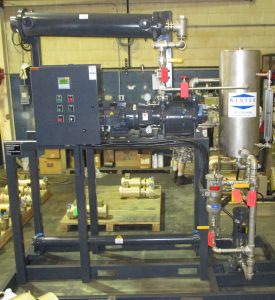
vacuum deaeration full recovery unit condenser, liquid ring vacuum system
Wintek SN 19108: Purpose is to dry aluminum powders to recover isopropanol, includes 7.5 HP Liquid Ring Vacuum Pump

FAQs about Vacuum Deaeration

Vacuum deaeration is a process that removes dissolved and entrained gases, most commonly oxygen and other air components, from a liquid by exposing it to reduced pressure. Removing these gases is important because dissolved oxygen can cause corrosion, oxidation, or unwanted reactions in downstream equipment or the final product.

Gas solubility in a liquid decreases as pressure decreases, following the relationship described by Henry’s Law. By lowering the pressure above the liquid, dissolved gases become less soluble and come out of solution as bubbles, which then rise and are removed from the system.

Boiler feedwater treatment, pulp and paper processing, food and beverage production, pharmaceutical manufacturing, and oil and gas processing all commonly use vacuum deaeration wherever dissolved oxygen or other gases need to be minimized for corrosion control or product quality reasons.

Dissolved oxygen in boiler feedwater accelerates corrosion of boiler tubes, piping, and other metal components at elevated temperatures, so removing it through deaeration helps protect equipment, extend service life, and reduce the need for chemical oxygen scavengers.

Thermal deaeration relies primarily on heating the liquid, typically with steam, to reduce gas solubility and drive off dissolved gases, while vacuum deaeration achieves gas removal primarily through reduced pressure and can operate at lower temperatures, which is useful for heat sensitive products or where steam isn’t readily available.

Increasing the liquid’s surface area, often through spray nozzles, packed towers, or trays, allows dissolved gas to escape more readily by giving bubbles a shorter path to the surface and creating more contact area between the liquid and the vacuum space above it.

Liquid ring vacuum pumps are a common choice for deaeration systems, since they reliably handle the water vapor drawn off along with the removed gases and provide a steady, robust vacuum source suited to continuous process operation.

Required vacuum level depends on the specific application and target dissolved gas concentration, but many deaeration systems operate in a range that balances achievable oxygen reduction against the energy cost of pulling a deeper vacuum, with deeper vacuum generally producing lower residual dissolved gas levels.

Yes, vacuum deaeration also removes other dissolved gases such as carbon dioxide and nitrogen, which can be important in applications like beverage production where dissolved CO2 levels need to be controlled, or boiler systems where CO2 contributes to corrosion alongside oxygen.

Higher liquid temperature generally reduces gas solubility and can improve deaeration efficiency, but it also increases water vapor load on the vacuum system, so many systems balance operating temperature against vacuum pump sizing and energy consumption to optimize overall performance.

Yes, it is widely used to remove dissolved oxygen from products like juices, dairy products, and other liquids, since oxygen can cause oxidation, flavor degradation, color changes, and reduced shelf life if not adequately removed before packaging.