
Building materials, metals and mining industries often use vacuum degassing to strengthen products. Additionally, plastics and rubber manufacturing facilities utilize degassing processes.

Degassing removes encapsulated gasses from compounds caused by mixing components. For example, a step in the process of resin and epoxy manufacturing can trap gasses within the compound. This gas can be the cause of structural failures and points of weakness if not removed. Gasses in these compounds are detrimental in the finished cast or cure because the pockets of gas cause nodules, cavities, or hollows.

In terms of metals and mining, vacuum degassing yields stronger steel. Vacuum degassing removes hydrogen gas from molten steel so as to prevent defects like hydrogen flaking. Hydrogen flaking decreases the yield strength of steels and can cause structural failure if left untreated.

The purpose of steel degassing include the reduction of dissolved gases, reduction of dissolved carbon to create more ductile steel, and oxidation of dissolved carbon over chromium when refining stainless steel grades. Because numerous load-bearing applications use steel, it is imperative to use the highest strength material possible. Degassing this metal is one way to increase the tensile strength of the material.

Vacuum degassing is essential in terms of plastics and rubber manufacturing because it can affect the integrity of the cast or mold and damaged products in finished process.

Wintek generally utilizes the ruggedness and robustness of the liquid ring vacuum pumps for degassing applications. During the process, there’s a chance for some process carryover that the liquid ring pump can handle without issue.
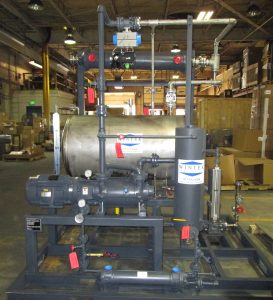
vacuum degassing condenser/receiver liquid ring vacuum system
Wintek SN 19043: vacuum level 29" HgV, Single-stage Liquid Ring Vacuum Pump, Nominal 100 ACFM Capacity

FAQs about Vacuum Degassing

Vacuum degassing is a broader term for removing dissolved or entrained gases from a liquid or molten material under reduced pressure, and it’s used across a wider range of applications than deaeration, which specifically refers to oxygen and air removal from process liquids. Degassing can also apply to removing hydrogen, nitrogen, or other gases from molten metals, as well as CO2 or dissolved air from liquids like wine, oils, or resins. Wintek supports these applications with liquid ring vacuum pump systems designed to handle vapor loads and process carryover while maintaining consistent, reliable vacuum performance.

Gas solubility drops as pressure decreases, so exposing a liquid or molten material to reduced pressure causes dissolved gases to come out of solution and form bubbles that rise to the surface and escape, following the same underlying principle described by Henry’s Law. Wintek applies this principle by designing vacuum systems that consistently achieve the required pressure levels, helping customers improve product quality while maintaining stable, reliable operation.

Steelmaking and metal casting, oil and lubricant processing, resin and polymer manufacturing, wine and beverage production, and semiconductor or electronics manufacturing all use vacuum degassing, though the specific goals and equipment vary significantly by industry. Wintek can work with the customer to achieve these goals at a cost-effective rate.

Vacuum degassing removes dissolved air and moisture from hydraulic fluids, lubricating oils, and transformer oils, which helps prevent foaming, oxidation, and cavitation in downstream equipment while also improving the fluid’s dielectric properties in electrical applications like transformers.

Removing entrained air and volatile byproducts from resins or polymer melts prevents bubbles, voids, or surface defects in the finished product, which is especially important in casting, potting, and encapsulation applications where trapped gas can compromise structural integrity or appearance. Wintek’s vacuum systems are suited to this task because of their efficient design and ability to adhere to custom specifications.

Equipment choice depends on the specific application and required vacuum depth, but Wintek often uses liquid ring vacuum pumps for many liquid degassing systems due to their tolerance for vapor and moisture, while steel degassing operations often use multi stage steam ejector systems or hybrid ejector and liquid ring combinations to achieve the very deep vacuum levels required.

Key factors include the depth of vacuum applied, the temperature of the liquid or molten material, the surface area exposed to the vacuum, residence time under vacuum, and in circulation methods, how effectively the material is mixed or cycled through the vacuum zone.