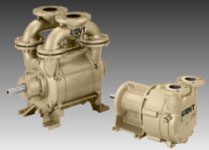
Oil-Sealed Vacuum Systems

Dekker Vmax

Dekker Vacuum Technologies (DVT’s) Vmax system is the result of years of experience in the design, manufacture, operation and application of the oil-sealed liquid ring vacuum pump system concept.

  • All Vmax systems feature liquid ring vacuum pumps manufactured to IS09001 quality control standards. Single-stage, high efficiency liquid ring vacuum pumps are available up to 10,000 CFM with vacuum capabilities up to 29.5″Hg. Two-stage pumps available for higher capacity at deeper vacuum applications.
  • Air-cooled operation (water-cooled is optional), which means these systems can be implemented in any type of plant.
  • The DVT patented DX-5 air/oil separator design features five stages of separation, and hence is the best air/oil separation in the industry.
  • Another advantage of the DX-5 separator is the structural design. The tank is cylindrical, resulting in superior strength, which is very important on units operating with back pressure. This design also eliminates possible leaks associated with square tank designs.
  • Vmax oil vacuum pump systems are extremely quiet in operation with sound levels generally in the 75-80 dBA range.
  • The Vmax systems can also operate at low vacuum without overheating due to the amount of heat the oil sealant can absorb.
  • DVT offers an unparalleled full 3-year warranty on Vmax systems*.
  • A wide range of standard system configurations is maintained in our inventory for quick shipments or for emergencies when a system is down.
  • Oil sealed vacuum pumps are great at achieving deeper vacuum than traditionally water-sealed vacuum pumps.
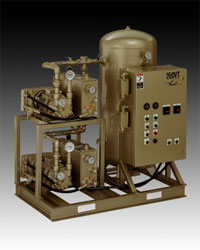
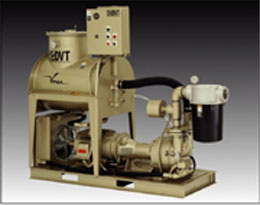
Performance Characteristics VmaxLT / Vmax Oil-Sealed liquid ring vacuum Systems

Vmax SystemMaximum
Capacity
(CFM)
Maximum
Vacuum
("HgV)
Motor
(HP)
Pump
Speed
(rpm)
Noise
Level
(dBA)
Oil
Capacity
(gal)
Weight
(lbs)
VMX0035M352933450762390
VMX0082M7529.551750766480
VMX0102M10029.57.51750766540
VMX0152M15029.5101750766565
VMX0082K7529.551750764700
VMX0102K10029.57.51750765775
VMX0152K15029.5101750765875
VMX0202K20029.515175076121100
VMX0302K30029.520175076121250
VMK0450K45029.525175078131750
VMX0550K55029.540175078131850
VMX0650K65029.54096079173700
VMX0750K75029.550120079173700
VMX1000K100029.56096080304000
VMX1100K110029.575110080304000
VMX1200K120029.5100120080304000
VMX1500C180027.510074082consult factoryconsult factory
VMX2000C220027.512574082consult factoryconsult factory
VMX3000C310027.520055586consult factoryconsult factory
VMX4000C380027.520049586consult factoryconsult factory

FAQs about Oil-Sealed Liquid Ring Vacuum Systems

It’s a liquid ring vacuum pump that uses oil instead of water as the sealant liquid, operating on the same basic principle, a rotating ring of liquid forms a seal against an eccentric impeller to draw in, compress, and discharge gas, but with oil’s properties enabling different performance and application advantages.

Oil has a much lower vapor pressure than water, which allows the pump to achieve deeper vacuum levels since the seal liquid’s vapor pressure sets the practical floor on achievable vacuum. Oil is also used when the process gas would react with water, when water contamination of the process gas is unacceptable, or when air-cooling is most practical.

Because oil’s vapor pressure is significantly lower than water’s, oil-sealed liquid ring pumps can typically reach deeper vacuum levels than an equivalent water-sealed pump, often into the low single-digit torr range on a single stage, versus roughly 50–100 Torr for water-sealed units.

Selection depends on the application, but common choices include mineral oils and synthetic oils chosen for compatibility with the process gas, low vapor pressure, appropriate viscosity, and thermal/chemical stability under operating conditions. Process compatibility is critical, since the oil will be in direct contact with whatever gas or vapor is being handled.

This requires careful consideration. Water entrained in the gas stream can contaminate the seal oil over time, degrading its performance and vapor pressure characteristics. Wintek can evaluate the best vacuum technology for your application when it involved entrained water or solvent vapors.

Oil-sealed systems almost always run in a closed-loop configuration where oil is continuously recirculated through a separator, cooled via heat exchanger, and sometimes filtered or purified before returning to the pump.

The separator removes entrained oil from the discharged gas stream after compression, both to recover the oil for recirculation (reducing consumption and cost) and to prevent oil mist or carryover from contaminating downstream equipment or being released to atmosphere.

Oil is more expensive than water, requires more careful handling and disposal, and can degrade or become contaminated over time and need periodic replacement or reconditioning. Wintek works with each customer to determine which technology is best for a particular application.

Applications requiring deeper vacuum than water-sealed pumps can efficiently provide, where water contamination is unacceptable, or where cooling water is not available, such as certain chemical processing, vacuum hold-down, and soil vapor extraction.

Similar to water-sealed pumps, cooler seal oil has lower vapor pressure and improves achievable vacuum, so heat exchangers are typically used to actively cool the recirculating oil and maintain consistent performance, especially important since oil’s viscosity also changes with temperature and can affect pump efficiency.

It depends on gas compatibility with the specific oil chosen, oil is generally more chemically inert than water toward many reactive gases (avoiding hydrolysis reactions, for example), but the oil and all wetted materials still need to be verified compatible with the specific process chemistry.

Beyond standard liquid ring pump maintenance, oil-sealed systems require oil replacement or reconditioning on a schedule, and more attention to the separator and filtration system’s condition. Wintek uses specially-formulated sealing oil, which reduces maintenance costs by allowing systems to run up to 10,000 hours before an oil change!

This requires careful engineering, since many seal oils are themselves combustible, systems handling flammable gases need appropriate hazardous-area classification, explosion protection measures, and oil selection that minimizes ignition risk, similar to considerations in solvent recovery applications.

Oil-sealed liquid ring pumps can reach deeper vacuum than water-sealed liquid ring pumps and still retain the ability to handle some carryover, but dry pump technologies (like dry screw or claw pumps) often achieve even deeper vacuum with less consumable/fluid management overhead. The tradeoff typically comes down to gas composition, contamination tolerance needs, and lifecycle cost.