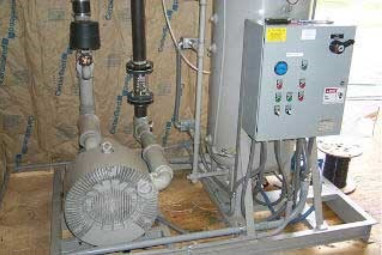
Soil Vapor Extraction | ACFM @ 15"HgV Regenerative SVE

ACFM @ 15″HgV Regenerative SVE

Soil Vapor Extraction (SVE)

Soil vapor extraction is a general term for pulling a vacuum on contaminated soils to remove volatile organic compounds (VOCs). The process has several different names including: High Vacuum SVE, Multi-Phase, Dual Phase, 2-Phase™. The choice of vacuum pump offered depends upon a number of factors, which include the vacuum level, desired reliability, and cost.

Straight “SVE”

Straight SVE only pulls vapors from the vapor zone above the water table. Typical systems include an inexpensive entrainment tank and filter before the vacuum pump. Since water carryover is not anticipated, there is usually no allowance for water accumulation. The standard pump used in this range is a regenerative blower.
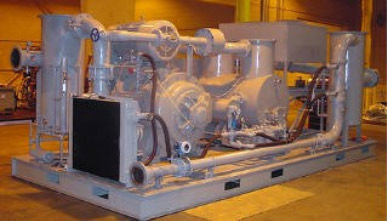
Soil Vapor Extraction System | Dual Phase SVE System | Knock Out Pot & Integrated Humidty Control

3000 cfm @ 26″HgV oil-sealed Dual Phase SVE system with inlet Knock-Out Pot and Integrated Humidity Control

High Vacuum SVE, Multiphase SVE, Dual Phase SVE, and 2-Phase™

These types of soil vapor extraction designs include groundwater entrainment carryover with the vapor flow. Additionally, these systems will include inlet knockout pots and water transfer pumps. Often, the purpose of pulling the higher vacuum on the soil is to increase the water yield from the well for treatment. Depending how tight the soil formation, however, high vacuum can increase the water yield by a factor of 10 times.

Vacuum levels for these designs are typically in the 10”HgV to 28”HgV range. In the 10” – 15”HgV range, you will typically see rotary lobe blowers and liquid ring vacuum systems (water and oil). However, in the 15-28”HgV range, you will almost exclusively find liquid ring vacuum system (water and oil) as the vacuum source. Capacities can range from 100 to 4,000 CFM.

Water-Sealed vs. Oil-Sealed Liquid Ring Vacuum Pumps

Wintek supplies both for soil vapor extraction applications. However, in terms of long term reliability, we recommend the oil-sealed version. Although it is not intuitive to use an oil-sealed pump on an environmental cleanup site, this design overcomes many of the problems encountered with water-sealed pumps. Although liquid ring pumps are rugged, the pumps also have drawbacks. The problem with water-sealed liquid ring pumps is the quality of the water (typically dirty and high in minerals – hard water) available at most sites.

The minerals tend to plate out on the pump internals, valves, and switches which causes system problems and down-time. These damages tend to start in the 2nd year of operation. Wintek’s oil-sealed liquid ring systems typically achieve 90-95% uptime over the 1st five years of operation, based on customer feedback.

Integrated Humidity Control Option for Soil Vapor Extraction Systems

This option may be desired when operating at vacuum levels in the 15”-28”HgV range, if you are utilizing vapor phase carbon on the system discharge. By nature of activated carbon, for optimal adsorption, the vapor stream to the carbon should be controlled in temperature and humidity at 50% RH and 90-110oF. High vapor temperatures and high humidity can impede adsorption of VOC’s on activated carbon, thus increasing a site’s on-going operating costs. Wintek’s Integrated Humidity Control System (US Patent 5,441,365) optimally conditions the vapors for carbon adsorption, thus keeping operating costs down.

2-Phase™ is a trademark of Xerox Corporation
FAQs about Soil Vapor Extraction (SVE)

Soil vapor extraction is a remediation technology that removes volatile and semi-volatile organic contaminants from the unsaturated (vadose) zone of soil by applying a vacuum through a network of extraction wells. The vacuum draws contaminated soil vapor toward the wells, where it’s collected, brought to the surface, and treated before being released or destroyed. Wintek supports these systems with engineered vacuum solutions, including oil-sealed liquid ring pumps that have demonstrated 90–95% uptime over the first five years of operation, helping ensure reliable, long-term remediation performance.

SVE works best on volatile organic compounds (VOCs) and some semi-volatile organic compounds (SVOCs) with sufficiently high vapor pressure to transition from adsorbed or dissolved phases into the soil gas phase, such as gasoline constituents, chlorinated solvents like TCE and PCE, and other light petroleum hydrocarbons. Wintek supports these applications with vacuum systems designed for a wide operating range (10”–28” HgV) and technologies like integrated humidity control to optimize downstream carbon adsorption, helping improve removal efficiency and reduce operating costs.

Contaminants with low vapor pressure, such as heavier oils, greases, or PAHs, don’t readily volatilize into soil vapor under the vacuum levels typically applied, making SVE inefficient or ineffective for these compound types compared to more volatile contaminants.

Soil permeability strongly influences how effectively vacuum can be transmitted through the subsurface and how well contaminated vapor can flow toward extraction wells, so coarse, permeable soils like sand typically respond well to SVE, while low permeability soils like clay or silt can significantly limit airflow and reduce system effectiveness.

A standard SVE system includes extraction wells screened in the contaminated interval, a network of piping connecting the wells to a vacuum source, a vacuum pump or blower to generate the extraction vacuum, a moisture separator or knockout tank to remove entrained water, and a vapor treatment system to handle the extracted contaminants before discharge. Wintek supplies these systems with proven components such as oil-sealed liquid ring vacuum pumps and integrated knockout pots, delivering reliable performance and long-term uptime in demanding field conditions.

Regenerative blowers and liquid ring vacuum pumps are used depending on the required vacuum level and flow rate, with liquid ring pumps often selected for sites where deeper vacuum is needed or where moisture and vapor conditions favor a technology tolerant of liquid carryover. Wintek provides both solutions, including oil-sealed liquid ring vacuum systems for higher vacuum applications (15–28” HgV) that offer improved reliability and resistance to the scaling issues common with water-sealed designs, helping maintain consistent performance in challenging SVE conditions.

Extracted soil vapor contains the contaminants being removed from the subsurface, so regulatory discharge limits typically require treatment before release, commonly using technologies like granular activated carbon adsorption, thermal or catalytic oxidation, or condensation, depending on contaminant type and concentration.

A pilot test is a short term trial extraction run at the site that measures achievable vacuum, airflow rates, and radius of influence under actual field conditions, providing the data needed to properly size and design the full scale system rather than relying on generic assumptions.

Yes, SVE is frequently paired with technologies such as air sparging, which injects air below the water table to volatilize contaminants that then migrate upward into the vadose zone for SVE capture, or with bioventing, which uses the induced airflow to also stimulate aerobic biodegradation of contaminants. Wintek supports these integrated approaches with vacuum systems designed to handle variable vapor and moisture loads, including oil-sealed liquid ring pumps that maintain reliable performance even with liquid carryover.

SVE operates above the water table in the unsaturated zone, using vacuum to extract vapor, while air sparging operates below the water table, injecting air to volatilize and strip contaminants from groundwater, with the two technologies often used together to address both saturated and unsaturated zone contamination.