
Vacuum Jet Ejector Systems

One method of extending the operating range for liquid ring vacuum pump (LRVP) systems is through the usage of vacuum jet ejectors, either a Steam Jet or and Air Jet. Both jets are capable of handling upsets (liquid carry-over) without damage resulting in minimal effects on operations.
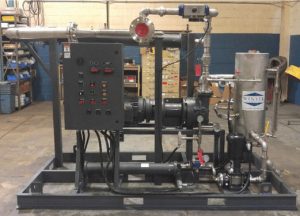
Hybrid Steam Jet Liquid Ring Vacuum SystemSteam Jet / LRVP Hybrid

Hybrid steam jet / liquid ring vacuum systems combine steam jets, or multiple jets, backed by condenser and liquid ring vacuum system. The jets utilize steam as the motive fluid which allows for fairly high single-stage compression ratios. Hybrid steam jet systems are capable of operation at 0.1 mmHgA and less.

Thus, Steam jet systems are best used in applications where steam is already available and the end-user is not concerned with adding water to the vapor stream.
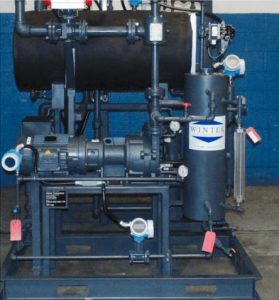
Hybrid Air Jet Liquid Ring Vacuum SystemAir Jet / LRVP Hybrid

Air jet liquid ring packages feature either atmospheric or pressurized air jets backed by liquid ring pumps. If using a recycled atmospheric motive air source you can minimize emissions from the system which can be a benefit in many situations. Also, atmospheric jets require no additional utilities because the motive fluid is air from the separator tank.

Atmospheric jets are typically capable of operation at 10 mmHgA. Thus, they are the most common method for extending the operating range of the liquid ring pump. However, they add to the required capacity of the liquid ring system via the motive fluid. Therefore, they are most practical in relatively smaller capacity applications.

FAQs about Vacuum Jet Ejector Systems & Hybrid Jet/Liquid Ring Systems

A jet ejector (also called a steam ejector or eductor) uses a high-pressure motive fluid, typically steam, air, or a liquid, forced through a converging-diverging nozzle at high velocity. This creates a low-pressure zone that entrains and draws in process gas, and the combined stream is then recompressed as it passes through a diffuser, discharging at a higher pressure with no moving parts involved.

Ejectors have no moving parts, making them extremely reliable, low-maintenance, and well-suited to handling corrosive, dirty, hot, or particulate-laden gas streams that would damage mechanical pumps. They’re also relatively simple to build from corrosion-resistant materials since there’s no need for tight rotating tolerances.

Steam jet ejectors use pressurized steam as the motive fluid and are common in large industrial vacuum applications like distillation and evaporation. Liquid jet ejectors instead use a pressurized liquid (often water) as the motive fluid, and are typically chosen for lower vacuum requirements or where steam isn’t available or practical on site.

A single-stage ejector typically achieves fairly modest vacuum, but multi-stage ejector systems, with ejectors arranged in series, often paired with intercondensers between stages, can reach much deeper vacuum, sometimes into the sub-Torr range depending on the number of stages and condensing efficiency.

An intercondenser sits between ejector stages and condenses out the motive steam and any condensable process vapors before the next stage. This dramatically reduces the volumetric load the next ejector stage has to handle, improving overall system efficiency and reducing steam consumption.

Steam ejectors consume significant amounts of motive steam, making them less energy-efficient than mechanical pumps in facilities without cheap or already-available steam. They also generally have less flexibility to adjust to varying load conditions compared to mechanical systems, since performance is tied closely to motive fluid pressure and flow.

Petroleum refining, chemical processing, power generation (condenser air removal), and any facility with an existing steam supply commonly use ejectors, particularly in applications with corrosive or high-temperature process gases.

FAQs about Hybrid Jet Ejector / Liquid Ring Systems

A hybrid system combines a jet ejector as a first stage with a liquid ring vacuum pump as the backing/second stage. The ejector handles the high-volume, low-pressure-differential work near the process, while the liquid ring pump compresses and discharges against atmosphere, similar in concept to a mechanically boosted liquid ring system but using an ejector instead of a Roots blower.

An ejector alone often can’t discharge directly to atmosphere efficiently, and a liquid ring pump alone may struggle to reach deep vacuum economically. Combining them lets the ejector handle the difficult low-pressure end of the process while the liquid ring pump efficiently compresses the higher-pressure exhaust to atmospheric discharge, playing to each technology’s strengths.

Yes, because the liquid ring pump backs up the ejector stage(s), fewer ejector stages (and therefore less motive steam) are typically needed to reach a given vacuum level compared to an all-ejector, multi-stage design.

Yes, this is one of their main advantages. Both the ejector and the liquid ring pump individually tolerate condensable vapors well, so the hybrid combination retains that same robustness while improving overall vacuum depth and efficiency.

The same principles apply, seal liquid vapor pressure and temperature set the practical vacuum floor for the liquid ring stage, so cooling the seal liquid or choosing solvent-compatible seal fluids matters just as much in a hybrid configuration as in a standalone liquid ring pump.

They’re common in vacuum distillation, deodorization (e.g., edible oil processing), chemical processing requiring deep vacuum with condensable or corrosive vapors, and any application where a facility has access to steam but wants better overall efficiency and turndown flexibility than a pure multi-stage ejector system alone.

Generally less, because the ejector stage has no moving parts (unlike a Roots booster), there’s less rotating equipment to maintain.

The choice often comes down to the specific vacuum depth and gas composition and other factors such as available utilities and turndown requirements. Wintek can provide a proper process evaluation to determine which configuration is most appropriate for a given site.