liquid phase MSDU wintek isopropyl alcohol dehydration

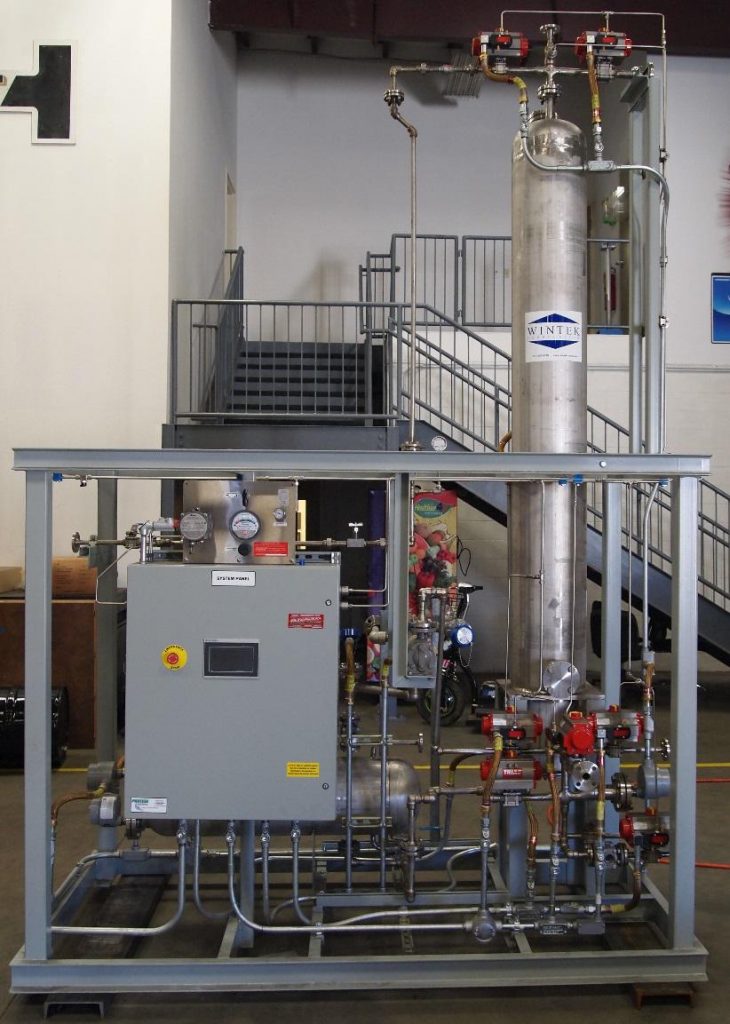
Liquid Phase Molecular Sieve Dehydration Unit

Isopropyl alcohol (C3H8O or CH3CHOHCH3 or (CH3)2CHOH) dissolves a wide range of non-polar compounds. In addition, it evaporates quickly, leaving nearly zero oil traces compared to ethanol. Compared to other solvents, IPA is also relatively non-toxic. Thus, it is widely used as a solvent and as a cleaning fluid, especially for dissolving oils.

Isopropyl alcohol (IPA) is miscible in water and forms an azeotrope. The azeotrope exists at a composition that is  91% IPA by volume and 9% water. Hence, simple distillation cannot achieve dryness levels below this.
However, isopropyl alcohol dehydration via molecular sieves has proven an effective means of drying IPA beyond the azeotrope.

Molecular sieves rely on the difference in molecular size between the solvent and water to achieve separation. IPA has a molecular size of ~16Å, and water has a molecular size of 2.6Å. A 3Å or 4Å molecular sieve adsorbs water while allowing the IPA to pass through the bed because of the difference in size. The molecular sieve beads then undergo a regeneration step that removes adsorbed water. The sieves then remove more water when wet IPA passes through during the next dehydration cycle.
Wintek designs and builds Isopropyl Alcohol Dehydration (IPA)  MSDUs (both Liquid Phase and Vapor Phase) depending upon the incoming water concentration and outgoing dryness requirements.

FAQs about Isopropyl Alcohol Dehydration using Molecular Sieve Dehydration Units (MSDUs)

Like ethanol, isopropyl alcohol (IPA) forms an azeotrope with water, at roughly 87–88% IPA by volume, meaning conventional distillation alone cannot concentrate it beyond that point since the vapor and liquid compositions become identical. To reach anhydrous or high-purity IPA (commonly 99%+), the remaining water must be removed using a separation method that isn’t limited by relative volatility.

An MSDU (Molecular Sieve Dehydration Unit) is the equipment package placed downstream of IPA distillation/rectification that removes residual water from near-azeotropic IPA vapor, producing anhydrous IPA suitable for applications requiring very low water content, such as electronics-grade or certain industrial and pharmaceutical uses.

Near-azeotropic IPA vapor is passed through a bed of molecular sieve adsorbent with a pore size engineered to admit small water molecules while excluding the larger IPA molecules. Water becomes trapped within the sieve’s pore structure, and the dehydrated IPA vapor exits the bed for condensation into anhydrous liquid product.

As with ethanol dehydration, 3A molecular sieve is the standard choice, since its pore opening is sized to admit water molecules while excluding IPA molecules, which are larger. This size-exclusion mechanism is what allows the azeotrope to be broken without relying on relative volatility.

Most systems use two or more beds in a swing configuration, so one bed actively dehydrates IPA vapor while another undergoes regeneration, allowing continuous, uninterrupted production of anhydrous IPA.

Regeneration is achieved by desorbing the trapped water from the saturated bed, typically using either a heated purge gas/vapor stream or vacuum-assisted regeneration, depending on the individual process

In vacuum-regenerated designs, a vacuum pump, commonly a liquid ring vacuum pump, reduces pressure on the bed being regenerated, allowing adsorbed water to desorb at a lower temperature than would be required under atmospheric-pressure thermal regeneration alone, improving overall energy efficiency.

Liquid ring pumps tolerate the vapor and condensate mixture present during regeneration well, provide a robust and relatively simple vacuum source, and handle any carryover without damage.

The desorbed vapor stream, which still contains some recoverable IPA along with water, is typically condensed and routed back to an earlier point in the distillation train for reprocessing, minimizing product loss from the dehydration step.

Depending on the technology employed, water concentrations can be less than 10ppm, meeting specifications required for high-purity industrial, electronics, or certain pharmaceutical-grade applications where water content must be tightly controlled. Wintek can select the appropriate dehydration technology based on each customer’s unique requirements.

Common causes include fouling from process contaminants or impurities carried over from upstream distillation, incomplete regeneration leaving residual moisture on the sieve, and general sieve degradation from repeated thermal or mechanical cycling: similar failure modes to those seen in ethanol MSDU systems.

Electronics manufacturing (where anhydrous IPA is used for cleaning and processing), pharmaceutical production, specialty chemical manufacturing, and any application requiring high-purity, low-moisture IPA beyond what standard distillation can achieve.

Similar to ethanol, older methods for breaking the IPA-water azeotrope (such as azeotropic or extractive distillation using entrainer chemicals) have largely been replaced by molecular sieve dehydration, since MSDUs avoid extra chemical entrainers, reduce energy consumption, and simplify plant operation.

Depending on the MSDU technology Wintek selects, steam, cooling water, chilled water, nitrogen, and/or electric heating may be required. Wintek works with customers on a case-by-case basis to evaluate available utilities and design systems to minimize operating costs.