
The Purpose of MSDUs for Ethanol Dehydration

The separation of water and ethanol is particularly challenging due to the formation of an azeotrope at ~95 volume % ethanol/water. Achieving further component separation is impossible through traditional means at this concentration of ethanol and water at atmospheric pressure. This is because the composition of components in the liquid phase and gas phase are equivalent. There are a few ways to get around this limitation. However, Wintek focuses on the physical separation technique that utilizes molecular sieves. Molecular sieves are synthetic beads with small pores. The pores are large enough to allow water molecules to pass through but small enough to restrict the flow of ethanol into the beads.

The water saturates the beads, while the dry ethanol passes through the system. High temperatures and a pressure swing vaporize the water within the beads. The beads are re-used for further separation. This technique is a physical separation, meaning the azeotrope does not limit the ability to remove the water.

Wintek designs and operates Ethanol Dehydration Molecular Sieve Dehydration Units (MSDUs) custom-designed to remove water content, allowing ethanol recycling.

Wintek’s Ethanol MSDUs Are Highly-Efficient Designs Providing:

  • Ability to process from ½ gpm to over 25 gpm of wet alcohols and solvents
  • 90-95% solvent recovery rates
  • Energy consumption less than competing technologies
  • Minimal operator intervention
  • Ability to handle a wide variation in feed concentrations (0-10% water by volume, up to 15% possible).
  • High purity: Standard Dryness: >99.5% (<5,000 ppm water)
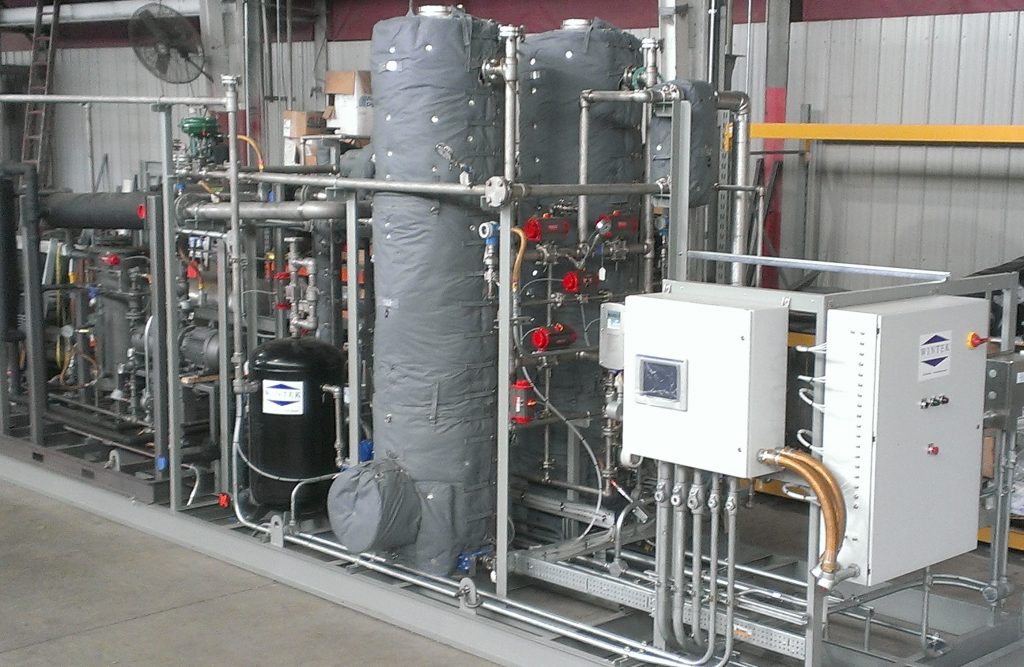
gas phase msdu molecular sieve dehydration unit
Wintek SN 130114: Ethanol dehydration MSDU, 1.75 gpm methanol/water mix with 5.0 wt% water, dehydrated to 99.5 wt% water

FAQs about Ethanol Dehydration using Molecular Sieve Dehydration Units (MSDUs)

Conventional distillation can only concentrate ethanol up to about 95–96% by volume because ethanol and water form an azeotrope at that concentration, meaning the vapor and liquid phases have the same composition and no further separation occurs through distillation alone. To reach fuel-grade ethanol (typically 99.5%+ purity), the remaining water must be removed using a different separation technology.

An MSDU (Molecular Sieve Dehydration Unit) is the equipment package that removes the final water content from near-azeotropic ethanol vapor, typically positioned downstream of the distillation and rectification columns, taking in ~190-proof ethanol vapor and producing anhydrous (essentially water-free) fuel-grade ethanol.

The ethanol vapor is passed through a bed of molecular sieve adsorbent with a pore size (typically 3 angstroms) engineered to be large enough to admit water molecules but too small to admit ethanol molecules. Water is selectively trapped within the sieve’s pore structure while the ethanol vapor passes through largely unaffected, exiting as dehydrated product.

Water molecules are smaller than ethanol molecules, and 3A sieve pore openings are sized specifically to allow water in while excluding ethanol, which is a larger molecule. This size-selective exclusion is what makes molecular sieve technology effective for breaking the ethanol-water azeotrope, unlike distillation which can’t separate them by boiling point alone.

Most MSDUs use two or three beds arranged so that at least one bed is actively dehydrating ethanol vapor while another is being regenerated, allowing continuous production without interrupting the ethanol flow through the plant.

Regeneration is typically done using a vacuum or a slipstream of hot vapor (often recycled from earlier in the process) passed through the bed in reverse flow to desorb the trapped water. Wintek has designed MSDUs for ethanol dehydration using both pressure and temperature swing adsorption/regeneration, depending on what is best for the particular process.

In vacuum-regenerated MSDU designs, a vacuum pump (commonly a liquid ring vacuum pump) is used to pull a vacuum on the bed being regenerated, lowering the pressure so that adsorbed water desorbs from the sieve at a lower temperature than would be needed under atmospheric regeneration, improving energy efficiency.

Liquid ring pumps handle the ethanol and water vapor mixture present during regeneration well, tolerate any condensate carryover, and provide a relatively simple, reliable, and robust vacuum source.

The desorbed vapor, which still contains recoverable ethanol along with the water, is typically condensed and routed back to an earlier point in the distillation process for reprocessing, minimizing ethanol product loss from the dehydration step.

Wintek’s vapor phase MSDUs typically produce anhydrous ethanol at 99.5% purity or higher, meeting fuel-grade (fuel ethanol) specifications suitable for blending with gasoline, while Wintek’s liquid phase MSDUs can achieve water concentrations of less than 10ppm.

Common causes include contamination from carryover of heavier compounds (like fusel oils or other fermentation byproducts) that foul the sieve surface, inadequate regeneration leaving residual moisture on the sieve, and general sieve attrition or thermal degradation over repeated adsorption/regeneration cycles.

Service life varies with plant operating conditions and feed quality, but sieve charges commonly last on the order of 3 to 5 years, with proper regeneration practices and feed pretreatment being key factors in maximizing bed life.

Molecular sieve dehydration has largely replaced older azeotropic distillation methods (which historically used benzene or other entrainers to break the ethanol-water azeotrope) because MSDUs avoid the use of toxic entrainer chemicals, offer lower energy consumption, and are simpler to operate.

Depending on the MSDU technology Wintek selects, steam, cooling water, chilled water, nitrogen, and/or electric heating may be required. Wintek works with customers on a case-by-case basis to evaluate available utilities and design systems to minimize operating costs.

While most commonly associated with fuel ethanol plants, molecular sieve dehydration is also used in beverage-grade and industrial-grade ethanol production wherever anhydrous or near-anhydrous ethanol is required, though specific design details may vary by application and purity target.