
Distillation is the process of separating components by applying and removing selective amounts of heat. Components with lower boiling points vaporize while the higher boiling point components remain a liquid. This separation typically takes place in a distillation column. The vaporized components condense and collect in a receiver after leaving the tower as a product.  Industrial vacuum distillation is whan this process takes place under pressures less than atmospheric.

How Vacuum Supports Distillation Columns

Vacuum is particularly useful for distillation because compounds experience lower boiling points when under low pressure conditions. This means the components require less energy to heat up and vaporize large amounts within the tower. Depending on the application, vacuum reduces operating costs in separation columns.

Another benefit comes in applications involving polymer formation. Some polymer synthesis techniques utilize distillation columns. Because traditional distillation columns usually operate at high temperatures, the polymer product must be protected from degradation. By reducing the operating pressure of the distillation tower, the bottoms temperature can be lowered. In this case, lower temperature is necessary to prevent polymer degradation.

Wintek has provided process vacuum systems to support industrial vacuum distillation columns for numerous applications in the flavors, fragrance and biodiesel industries, among others. Typically, these applications require deep vacuum. Wintek has designed water or oil-sealed boosted liquid ring vacuum system packages with either steam jets or rotary lobe blowers to achieve the low operating pressures required.
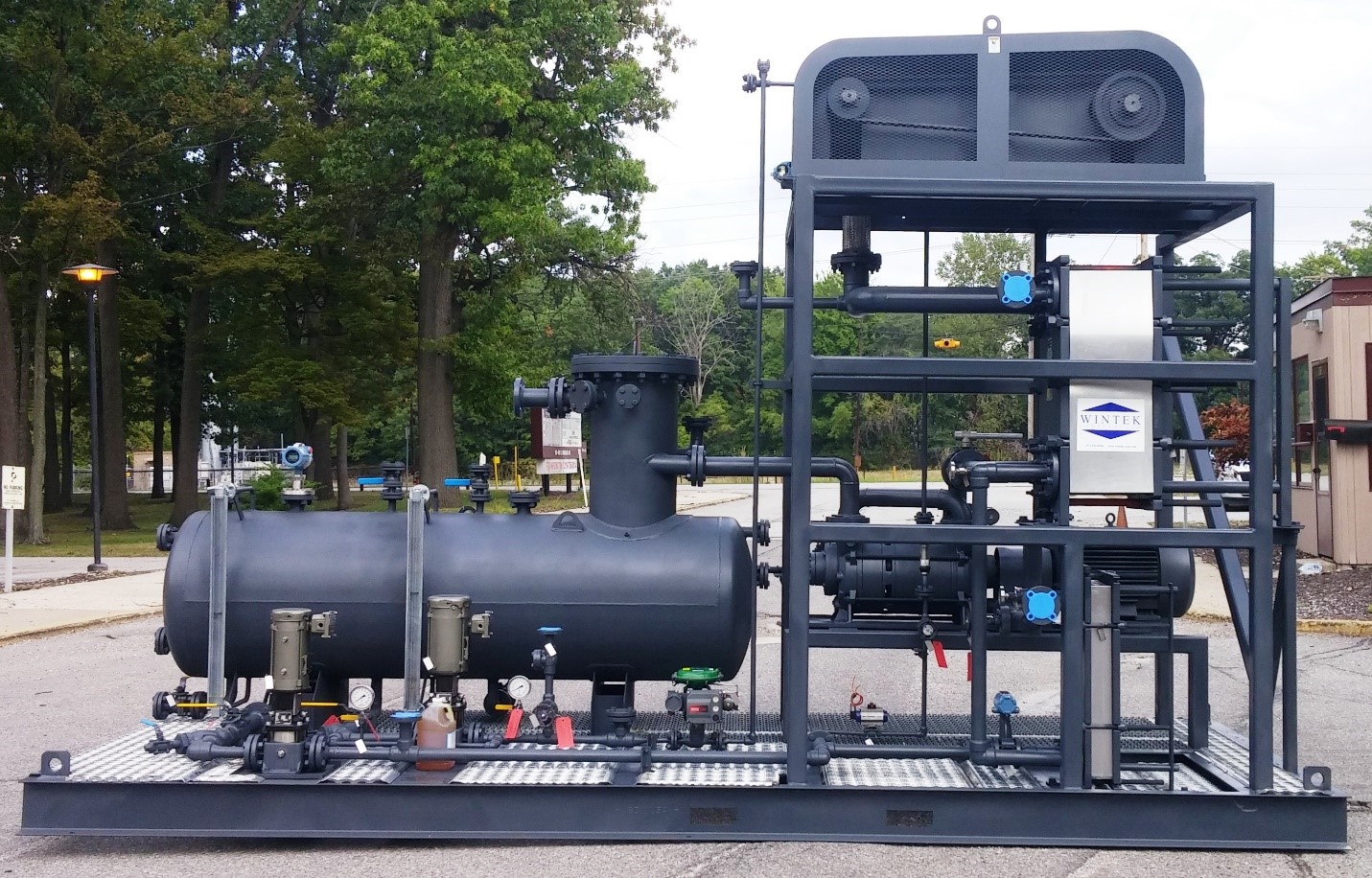
vacuum distillation boosted, condenser, liquid ring vacuum system
Wintek SN 150220: Limonene and Water removal from Hydrocarbons, Total Mass Flow: 275.7 kg/hr, Vacuum level 6.5 kPa

FAQs about Vacuum Distillation

Vacuum distillation separates components of a liquid mixture by boiling it under reduced pressure rather than at atmospheric pressure. Lowering the pressure reduces the boiling point of the components, allowing separation to occur at lower temperatures, which is especially valuable for materials that would degrade, decompose, or react undesirably if heated to their normal atmospheric boiling point. Wintek supports these applications with engineered vacuum systems, including boosted liquid ring configurations with steam ejectors or mechanical boosters, designed to achieve the deep vacuum levels required for efficient, low-temperature separation.

A liquid boils when its vapor pressure equals the surrounding pressure, so reducing the pressure above the liquid means it takes less thermal energy for the liquid’s vapor pressure to reach that lower threshold, allowing boiling to occur at a correspondingly lower temperature. Vacuum distillation leverages this to utilize less energy to seperate liquid components.

Heat sensitive materials such as certain heavy crude oil fractions, edible oils, pharmaceutical compounds, polymers, and other high boiling point or thermally unstable substances are commonly processed under vacuum to avoid thermal decomposition, discoloration, or unwanted side reactions that would occur at higher atmospheric boiling temperatures. Wintek supports these applications with vacuum systems designed to achieve and maintain the deep pressures needed to protect product quality while improving separation efficiency in demanding processes.

In refining, vacuum distillation is typically applied to the heavy residue left over from atmospheric distillation, separating it into additional valuable fractions such as vacuum gas oil and lubricating oil stocks, which would otherwise require excessively high temperatures to distill at atmospheric pressure, risking thermal cracking of the material.

Common vacuum sources include multi stage steam jet ejector systems, liquid ring vacuum pumps, and hybrid combinations of ejectors with liquid ring backing pumps, with the choice depending on the required vacuum depth, gas composition, and whether steam is readily available on site. Wintek helps evaluate these factors to design optimized systems, often integrating boosted liquid ring configurations to achieve reliable deep vacuum performance across a wide range of process conditions.

Multi stage ejectors, often paired with intercondensers between stages, can achieve very deep vacuum levels needed for some heavy oil or specialty distillation applications, since staging the compression across multiple ejectors allows each stage to handle a smaller pressure ratio, improving overall achievable vacuum.

Pressure drop refers to the loss of pressure as vapor flows through the column internals, and in vacuum systems this is especially important because even small pressure drops represent a much larger percentage of the very low absolute pressures involved, so minimizing pressure drop is essential to maintaining effective vacuum and proper separation throughout the column. Wintek accounts for these sensitivities when designing vacuum systems, ensuring adequate capacity and stable operation to maintain target pressures across the entire process.

Condensers positioned ahead of the vacuum pump or ejector system knock out the bulk of the overhead vapor as liquid, reducing the load on the vacuum equipment and improving overall system efficiency, with any remaining non condensable gases handled by the vacuum pump or ejector itself.

Even small air leaks into a vacuum distillation system add unwanted non condensable gas load that must be removed by the vacuum equipment, which can reduce achievable vacuum, increase energy consumption, and in some cases introduce oxygen that could react with sensitive process materials, so leak tightness is an important design and maintenance consideration. Wintek designs vacuum systems with the capacity and stability to handle variable non-condensable loads, helping maintain performance even as real-world conditions fluctuate.

Petroleum refining, edible oil processing, pharmaceutical and fine chemical manufacturing, essential oil and fragrance production, and various specialty chemical processes involving heat sensitive or high boiling point materials all commonly rely on vacuum distillation.

Common causes include air in leakage through seals, gaskets, or fittings, fouling or scaling within the column or condenser, vacuum pump or ejector performance decline due to wear or seal liquid issues, and buildup of non condensable gases that weren’t adequately removed from the system. Wintek helps address these challenges by evaluating system performance holistically and supplying vacuum solutions designed for consistent operation, even in the presence of variable loads and real-world process conditions.