
Vacuum hold down is an important component in any process utilizing a CNC router. The woodworking industry is a major industry that uses CNC routers. CNC routers usually use one or more vacuum pumps to “hold down” the process material (wood, composite, plastics, etc.) to the router table. The vacuum can hold the material against the table without damaging or distorting the material. This eliminates the need for fixtures like clamps.

The material to be machined is placed on top of rubber pots connected to a vacuum pump. The vacuum creates a low pressure underneath the materials. Barometric pressure will be much greater than the pressure underneath the materials. As a result, the material pushes down on the table. However, the level of CNC vacuum hold down that can be achieved in this process is determined by the amount of non-condensable leakage through the materials and into the vacuum system. Too high an air flow rate will limit the minimum operating pressure allowed.

Generally, Wintek would recommend using an oil-sealed liquid ring vacuum system for vacuum hold-down applications due to its high reliability and low utility cost. Additionally, Wintek offers inlet filtration vessels used to prevent the liquid ring vacuum system from seeing process carryover. We also recommend frequent oil changes to ensure the sealant is not damaging the inside of the vacuum pump. Wintek has provided oil-sealed liquid ring vacuum systems to numerous woodworking companies.
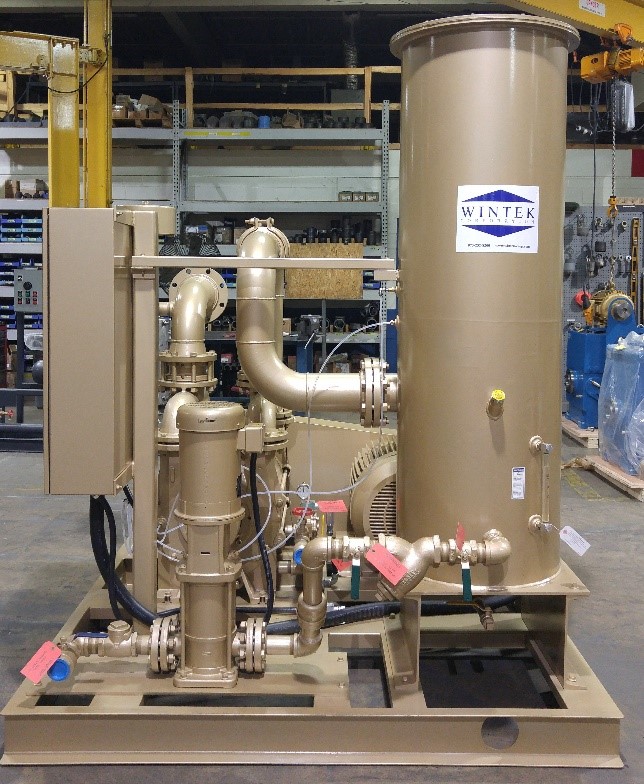
vacuum hold down liquid ring vacuum system, high capacity
Wintek SN 150716: ~1,100 CFM capacity oil-sealed, liquid ring vacuum system.

FAQs about Vacuum Hold Down

A vacuum hold down system uses a vacuum pump to create a pressure differential across a workpiece placed on a perforated or porous table surface, using atmospheric pressure to clamp the material firmly in place for machining, cutting, or other processing operations without the need for mechanical clamps.

Vacuum hold down allows full access to the top and edges of a workpiece without mechanical clamps or fixtures getting in the way of cutting tools, enables faster part loading and unloading, provides even, distributed holding force across the material, and works particularly well with thin, flat, or flexible materials that would be difficult to clamp mechanically without distortion.

Common applications include CNC routing and machining of wood, plastic, and composite panels, sign making and engraving, sheet metal processing, thermoforming, and various woodworking operations where flat sheet stock or panel material needs to be securely held during processing.

A vacuum table is a work surface with a network of internal channels or a porous structure connected to a vacuum source, typically featuring a grid of small holes or a permeable material like MDF spoilboard that allows vacuum to be distributed evenly across the table surface and applied through the workpiece.

Holding force depends on the vacuum level achieved and the effective surface area of the workpiece exposed to vacuum, since the clamping force is essentially the pressure differential multiplied by that area, meaning larger parts or deeper vacuum levels generally produce proportionally greater holding force.

Regenerative blowers and rotary vane vacuum pumps are common choices for many hold down applications due to their ability to move relatively high airflow at moderate vacuum levels, while many larger industrial systems use oil-sealed liquid ring vacuum pumps, particularly where continuous duty cycles or more demanding vacuum requirements are involved.

Zoning divides a vacuum table into separate sections that can be individually controlled, allowing vacuum to be applied only to the specific area covered by a workpiece rather than the entire table surface, which improves holding efficiency, reduces wasted airflow, and allows multiple smaller parts to be processed without pulling unnecessary vacuum across uncovered areas.

Common causes include air leakage around the workpiece perimeter due to inadequate sealing, insufficient vacuum pump capacity for the table size or number of open zones, clogged or worn spoilboard material restricting airflow, and cutting or machining forces that momentarily exceed the available holding force at a given vacuum level.

Larger exposed table area or multiple open zones increase the total airflow the vacuum pump must handle to maintain adequate vacuum level across the surface, so pump sizing needs to account for the maximum anticipated open area rather than just the workpiece size alone.

Yes, but these features can create air leakage paths that reduce holding effectiveness, so techniques like masking unused holes, using zoned vacuum control, or adding sacrificial material beneath the workpiece are commonly used to maintain adequate seal and holding force despite these complications.

Regular attention to vacuum pump performance, periodic cleaning or resurfacing of the table or spoilboard to prevent clogging, inspection of hoses and fittings for leaks, and checking gasket or sealing material condition are all important for maintaining consistent hold down performance over time.