
Vacuum evacuation of vessels is one of the most widespread applications in the world of vacuum technology. Generally, evacuation is removing gas and vapors from a physical space. Usually the application requires removing ambient air from a closed vessel. This is useful for vacuum testing vessels and central vacuum applications.

Vacuum leak-tests work by using a vacuum system to pull air out of a vessel. As evacuation occurs, the internal pressure of the vessel lowers. Afterwards, the operator isolates the system to the best of their ability by closing any valves entering or leaving the vessel. Finally, the operator records the pressure at the beginning and end of a specified time. The air leakage rate can be determined by a number of formulas, including the ideal gas law.

In these evacuation applications, it is typical to use an oil-lubricated rotary vane pump. These pumps are ideal for handling clean air due to their exceptional reliability and ability to pull to very deep vacuum levels (~0.1 Torr). Additionally, rotary vane pumps are quite cost-effective when compared to other vacuum pump types. Additionally, other options are oil-free rotary vane pumps and other dry vacuum pump designs depending on the evacuation application.

Wintek has extensive experience supplying rotary vane vacuum pump and other types of vacuum systems for evacuation and central vacuum applications.
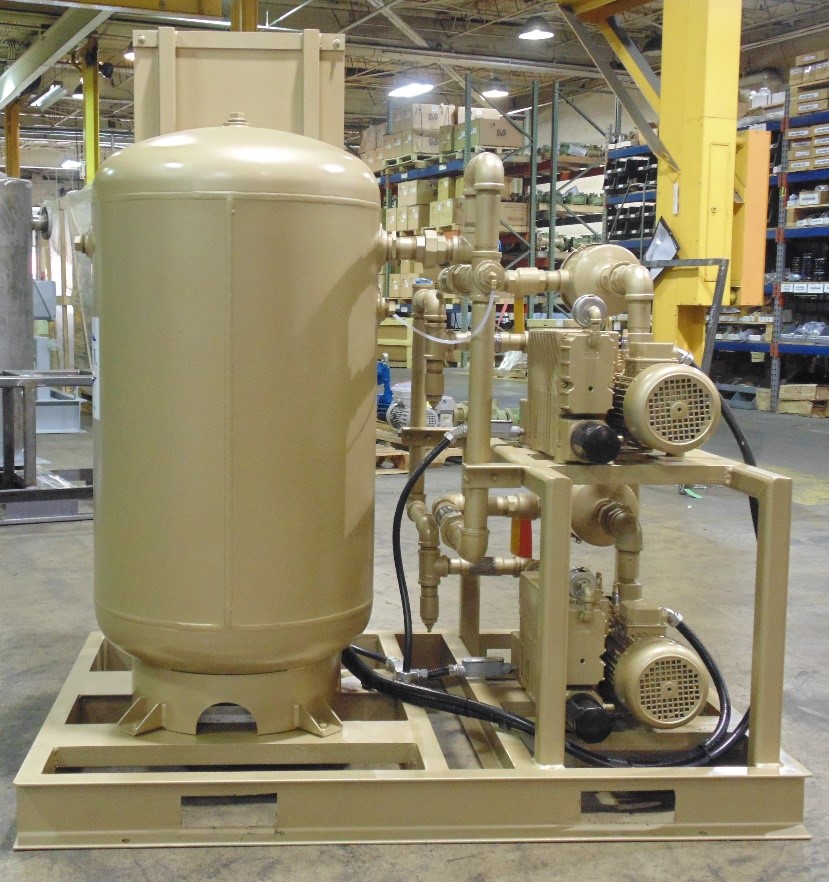
vacuum evacuation duplex rotary vane vacuum system
Wintek SN 150609: Stacked duplex rotary vane system, ~56 ACFM nominal capacity, 80-gallon ASME vacuum receiver tank

FAQs about Vacuum Evacuation

Vacuum evacuation refers to the process of removing air, moisture, and other gases from a closed vessel, pipeline, or system before it’s put into service, most commonly to prepare equipment for a specific process fluid, eliminate contamination, or verify system integrity, as opposed to vacuum processes that continuously operate to support an ongoing reaction, separation, or drying process. To achieve this effectively, Wintek Corporation supplies expertly designed rotary vane vacuum pump setups and dry systems engineered for high-reliability central vacuum and testing functions. Whether deploying single-stage configurations or advanced stacked duplex rotary vane systems with ASME vacuum receiver tanks, Wintek delivers the precise depth down to 0.1 Torr required for flawless leak testing and ambient air removal.

Common applications include evacuating refrigeration and air conditioning systems before charging with refrigerant, preparing pipelines for hydrocarbon or chemical service, evacuating vessels before introducing an inert atmosphere, removing moisture and air from insulated cryogenic piping, and pressure testing systems for leaks.

Residual air and moisture in a refrigeration system can cause a range of problems, including reduced system efficiency, formation of ice or acids inside the system that can damage components, and inaccurate pressure readings, so a proper deep evacuation is considered essential before refrigerant charging. To eliminate these critical performance issues, Wintek engineers custom oil-lubricated rotary vane systems engineered to pull the ultra-deep, precise vacuum levels necessary to thoroughly eliminate deep-seated moisture and ambient air.

This is common industry terminology for using a vacuum pump to reduce the internal pressure of a sealed vessel, pipeline, or system, typically to remove residual gases, verify there are no significant leaks, or prepare the system for the introduction of a new process fluid or refrigerant.

Required vacuum level depends heavily on the application, but many evacuation procedures target very low absolute pressures, since deeper vacuum improves moisture removal effectiveness and provides a more sensitive leak test than a shallow vacuum would allow. To easily achieve these tight tolerances, Wintek Corporation designs high-performance rotary vane systems engineered to pull deep down to 0.1 Torr, providing the reliable, deep absolute pressure your critical testing procedures demand.

Rotary vane vacuum pumps are extremely common for smaller scale evacuation work like refrigeration and air conditioning service, while larger industrial evacuation projects, such as pipeline or large vessel evacuation, may use liquid ring vacuum pumps or other higher capacity vacuum technology depending on the volume and vacuum depth required.

After pulling the system down to a target vacuum level, the vacuum pump is isolated and the system is monitored over time. A rising pressure trend indicates air or moisture is entering through a leak that may need to be located and repaired before proceeding. This process is sometimes call the “vacuum decay test”. To ensure a flawless decay test, Wintek Corporation custom-builds high-reliability rotary vane systems engineered to pull down to deep absolute pressures for precise leak detection.

Some procedures use repeated evacuation and inert gas backfill cycles, since this can be more effective at diluting and removing trapped air or moisture pockets in complex piping configurations than relying on a single continuous pump down alone.

Colder ambient temperatures can slow moisture evaporation and extend the time needed to achieve a satisfactory vacuum level, since lower temperatures reduce water’s vapor pressure, meaning evacuation procedures sometimes need to run longer or to a deeper vacuum target in cold conditions to fully remove moisture. Wintek Corporation bypasses cold-weather slowdowns by engineering high-capacity rotary vane systems that consistently pull down to 0.1 Torr, ensuring rapid and complete moisture removal regardless of ambient conditions.

Following evacuation, systems are often backfilled with an inert gas such as nitrogen to displace any remaining trace oxygen or moisture and to bring the system to a slightly positive pressure, which helps maintain system integrity and prevents ambient air from being drawn back in before the system is placed into final service.

Common causes include leaks in fittings, valves, or seals, residual moisture that continues to off gas and limit the achievable vacuum, an undersized or worn vacuum pump unable to reach the required depth, or trapped pockets of air or moisture in low points or dead legs within the piping that aren’t being effectively evacuated. Wintek Corporation eliminates these failure points by engineering custom, high-reliability rotary vane systems built to pull deep vacuums down to 0.1 Torr and keep your operations completely clear.

Refrigeration and HVAC service, oil and gas pipeline commissioning, cryogenic and industrial gas piping systems, semiconductor and vacuum chamber preparation, and general industrial equipment commissioning all commonly rely on proper vacuum evacuation as a standard part of system startup or service procedures.