
Rotary Vane Vacuum Pumps

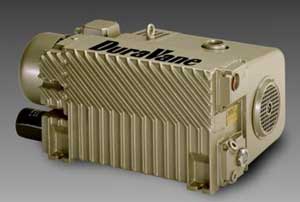
DuraVane Rotary Vane Vacuum Pump | Standard Version

These single stage, air-cooled and oil lubricated rotary vane vacuum pumps are well designed.  Moreover, they are reliable and cost competitive. The following two versions are available: Standard and Wet Service. Similar to the rotary piston pump, the rotary vane pump excel at handling clean, dry air. The single-stage pumps are ideal in industries including vacuum packing, lifting, chucking, paper converting, electronics, and printing because of their integrated oil-recirculation system. The “Wet Service” variant was specifically developed for high water content, such as stone and glass cutting.

The compact design of this vacuum pump make them great for lab-scale applications as well. Wintek commonly sells this type of vacuum pumps as central vacuum sources for laboratory and research facilities.

The standard versions are designed for relatively clean applications, but general industrial service are common as well. In addition, these vacuum pumps include an integral closed loop oil-circulation system utilizing long life composite vanes, heavy duty construction, direct drive, and compact. Also they have low noise levels.
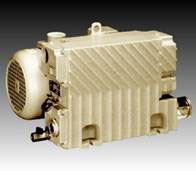
Features include:

  • Compact Simple Design
  • Direct Drive
  • Air-cooled (no cooling water)
  • Quiet Operation
  • Deep Vacuum Operation (to 29.9”HgV)
  • Oil Mist Elimination for 99.9% oil mist removal

Standard rotary vane vacuum pump equipment also has:

  • Composite (non-metalic) vane material, thus providing long life
  • TEFC High Efficiency motors
  • Integral exhaust filters
  • Spin-on oil filter
  • Anti-suck back valve
  • Gas Ballast Valve
  • Oil level gauge
ModelCFM
Displacement
End
Pressure
(Torr)
HPNoise @ 3'
(dBA)
Weight
(lbs)
Dimensions
RVL006H5.61.50.4602212"L x 7"W x 6"H
RVL010H8.51.50.75623517" L x 7"W x 6"H
RVL020H190.51.5655515"L x 11"W x 9"H
RVL031H280.52.06711019"L x 13"W x 10"H
RVL051H450.53.06911519"L x 13"H x 10"H
RVL076H750.54.07216528"L x 15"W x 11"H
RVL145HH1450.57.57635039"L x 21"W x 16"H
RVL212HH2120.5107044039"L x 21"W x 16"H

DuraVane Rotary Vane Vacuum Pump | Wet Service Vacuum PumpDuraVane-Wet Service

These single stage oil-lubricated rotary vane vacuum pumps handle saturated (water) air and also includes an integral oil/water separator with condensate drain valve.

ModelCFM
Displacement
End
Pressure
(Torr)
HPNoise @ 3'
(dBA)
Weight
(lbs)
RVL020W191.51.56556
RVL031W271.5267112
RVL051W451.5369118
RVL076W701.5472170

FAQs about Rotary Vane Vacuum Pumps

A rotary vane vacuum pump uses a cylindrical rotor mounted off-center within a housing, with multiple vanes fitted into slots along the rotor that slide in and out as it spins, maintaining contact with the housing wall due to centrifugal force or spring tension. As the rotor turns, the space between adjacent vanes expands to draw in gas, then contracts to compress and discharge it.

Most commonly, vanes are held against the housing wall either by centrifugal force generated as the rotor spins, ensuring a consistent seal is maintained between adjacent chambers throughout the rotation. Some designs may use spring-loaded vanes.

Oil sealed rotary vane pumps use oil to lubricate the vanes, fill microscopic gaps for sealing, and help dissipate heat, achieving deeper vacuum levels as a result, while dry rotary vane pumps operate without oil, often using self-lubricating vane materials like carbon composites, trading some ultimate vacuum performance for oil free, contamination sensitive applications.

Single stage oil sealed rotary vane pumps commonly reach into the range suitable for many general industrial and laboratory applications, while two stage designs can achieve deeper ultimate vacuum by adding a second compression stage, and dry rotary vane pumps typically reach somewhat more modest vacuum levels than their oil sealed counterparts.

A two stage pump routes gas through a second vane stage after the first, reducing the pressure ratio each stage has to handle individually, which allows the pump to reach a deeper ultimate vacuum than a comparably sized single stage pump could achieve on its own.

Oil quality directly affects the pump’s ability to maintain proper sealing between the vanes and housing, and contaminated, diluted, or degraded oil can allow gas to leak past these sealing surfaces internally, reducing both pumping speed and the depth of vacuum the pump can ultimately achieve.

Gas ballast introduces a controlled amount of air into the compression chamber during the pumping cycle, which helps prevent water vapor or other condensable gases from condensing inside the pump by keeping their partial pressure below the condensation point until they can be safely discharged, protecting the oil from contamination and moisture buildup.

Rotary vane pumps have some tolerance for water vapor, particularly when gas ballast is used, but excessive condensable vapor loading can contaminate the oil and reduce pump performance over time, making them less suited to consistently wet or heavily vapor laden process gas than technologies like liquid ring pumps.

Oil change frequency depends on the specific application, gas composition, and vapor or contamination levels the pump is exposed to, with cleaner, drier applications typically allowing longer intervals between changes than processes involving corrosive gases, moisture, or particulate contamination.

Common causes include oil contamination or degradation affecting sealing performance, worn or damaged vanes from abrasive particulates or extended wear, insufficient gas ballast for the vapor load present, and general mechanical wear of the rotor, vanes, or bearings over extended operation.

Common applications include laboratory and analytical instrumentation, HVAC and refrigeration system evacuation, vacuum packaging, medical and dental equipment, and various general industrial processes requiring moderate vacuum levels with relatively compact, cost effective equipment.

Routine maintenance for oil sealed models typically includes regular oil level checks and changes, monitoring oil condition and color for signs of contamination, vane inspection and replacement as needed, and periodic verification of achievable ultimate vacuum, while dry rotary vane pumps require inspection and eventual replacement of the self-lubricating vanes as they wear.